After far too long, there finally are some signs of improvement in the provision of bus services in Cheshire East. Some have gained Sunday services while others have become more frequent and there even is a new service in the offing as well. While this is nothing like a restoration to the levels of service last seen in 2010, it feels that things are a little bit better again, at least for now. After all, persistence will be essential for regaining trust.
Evening services remain scant, after all, and a change of administration could bring its own changes, especially when UK Government funding is helping to expand things from what they were. In any case, we are left with a network that would not survive without council funding, so added central government funding is a more positive development. Just like the Silk Town Ticket, these also need publicity to encourage their use and hence enhance their sustainability.
This is now composed of what once were three different services, making for some interesting travel options across Macclesfield town. Getting from Bollington to Macclesfield College or from Weston to Hurdsfield offers new possibilities for getting to and from work or education that were not so convenient before the amalgamations; there were two, one under Arriva and another under D&G Buses. Sunday journeys have been reinstated too, albeit at a sparser 90-minute frequency without early morning or evening services. Regaining what we now have needs to suffice for now in these cash-strapped times, and it is good to even have that much, especially when this is the only seven-day town service.
The main news is that Sunday journeys are back on this route, offering more possibilities for earlier getaways for day hiking trips; an 08:35 start could have its uses. While service frequency is at the 90-minute level and there are no evening services, having this is better than there being nothing at all, which is how it was for too long. On other days of the week, there is a near hourly frequency and early to late coverage of the day too, making this one of the hardier survivors from the culling of recent times.
While there are no Sunday services to report here, the Monday to Friday frequency between Macclesfield and Knutsford (service 87) has been enhanced. This is now near hourly, a situation that we have not had for the most of fifteen years. The Saturday service remains as it was, with five journeys in each direction between Macclesfield and Knutsford. The service 88 frequency between Knutsford and Wilmslow is near hourly too, a decrease from it was half-hourly quite a few years ago. Both routes are connected with the same bus going all the way between Macclesfield and Altrincham at certain points of the day, even if it is going the longer way around, particularly for travelling to Wilmslow.
This interurban stalwart is a shadow of its former self, though there again are Sunday services between Macclesfield and Handforth. These work to a 90-minute frequency and are operated by High Peak, while D&G Buses does the needful on other days of the week. Otherwise, it halts its extension to Manchester Airport from 24th November due to a decline in demand (my possessing a trolley case had me suspected of going to Manchester Airport recently when I was bound for Heathrow and needing to divert to Wilmslow to get there because of storm damage to overhead wires on the line between Macclesfield and Stockport; while connections are available at Wythenshawe for onward travel to the airport, I am left wondering if I had missed a trick by sticking with train travel all the time that there was a direct bus service) while also boosting its Saturday service frequency to hourly.
This is the new service of the bunch, starting on 24th November, complementing service from Monday to Friday when there are no bank holidays. However, it is a limited stop affair that calls only at the following stops depending on route direction:
Journeys towards Alderley Park and Wilmslow: Macclesfield Bus Station, Macclesfield Railway Station, Chester Road (Fire and Ambulance Station), Chester Road (Kershaw Grove), Chester Road (Ivy Road
junction), Chester Road (Toll Bar Road), Alderley Park (Alderley House), Alderley Park (Mereside), Alderley Edge (George Street), Wilmslow Railway Station.
Journeys towards Macclesfield: Wilmslow Railway Station, Alderley Edge (Chapel Road), Alderley Park (Mereside), Alderley Park (Alderley House), Chester Road (Shell Garage), Chester Road (Maxfield Close),
Chester Road (Ivy Road junction), Chester Road (Kershaw Grove), Chester Road (Clowes Street), Churchill Way (Tesco), Macclesfield Railway Station, Macclesfield Bus Station.
The use of Chester Road likely reinstates bus stops that have been unused since the combination of routes 4 and 19 following the departure of Arriva from the area. The service frequency is hourly at best, while consulting the timetable is much needed to pick up on any variations from this.
Night trains in Europe are enjoying a revival after years when many routes fell quiet. New trains have been ordered, services withdrawn in the 2000s have been restored and operators are stitching together a more coherent overnight network that reaches across borders.
The renewed interest has not appeared in a vacuum. Travellers who want to reduce their carbon footprint are looking for alternatives to short-haul flying, some countries have introduced or discussed taxes that make those flights less appealing and airport congestion has made predictable rail journeys more attractive. Political backing has helped too, notably in Austria, France and parts of Scandinavia, and investment in modern rolling stock has improved the experience on board so that a night on the rails feels more like a small moving hotel than a compromise.
The Major Operators
ÖBB Nightjet: The Market Leader
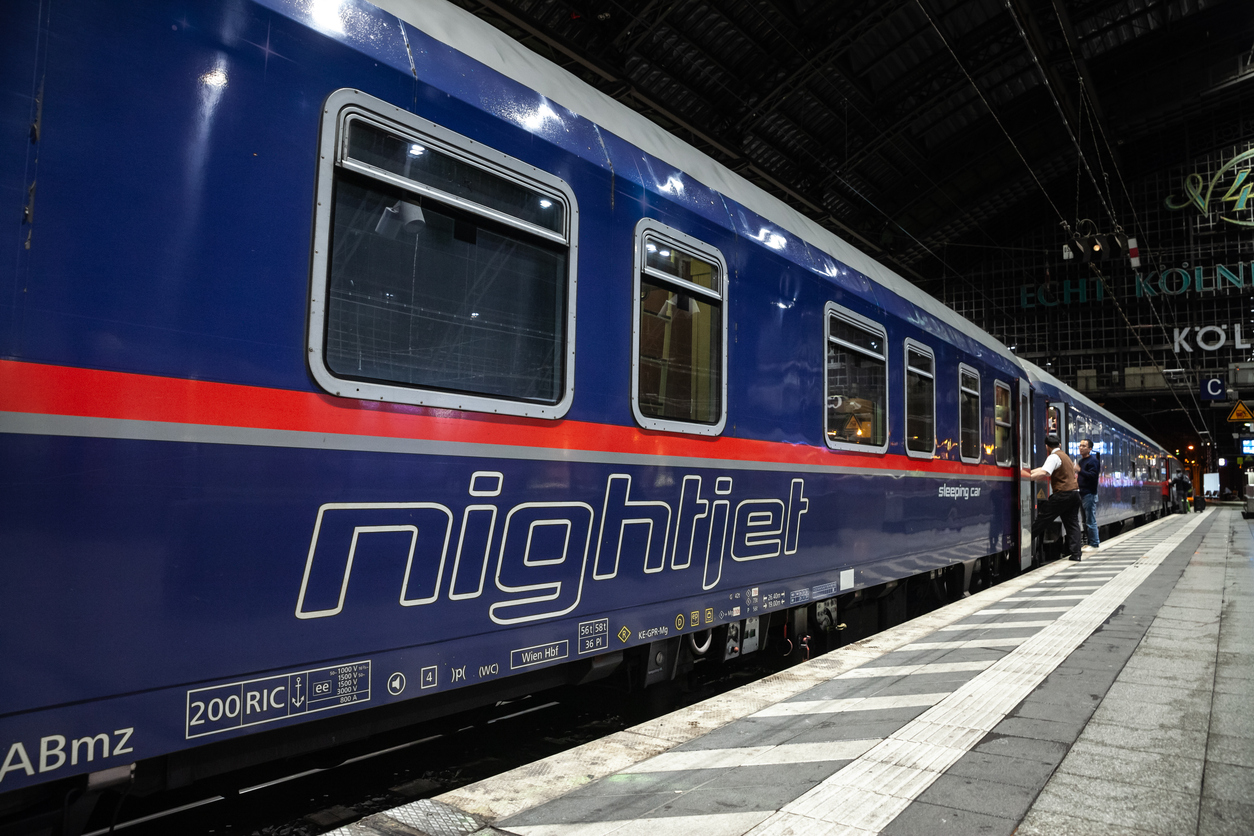
Austria’s ÖBB has turned Nightjet into the best known brand for cross-border sleepers. These trains link Austria and Germany with Italy, Switzerland and the Netherlands, and they have been joined by a new generation of carriages since December 2023. The original order for 33 new trains was revised in mid-2025, with 24 new Nightjet trains now planned alongside an expanded fleet of daytime Railjet services.
The incoming couchette and sleeping cars place a premium on privacy and security, with better compartment layouts, showers in some rooms and dedicated storage for bicycles. The new generation includes innovative mini cabins for solo travellers, offering maximum privacy in a compact space with a proper bed, storage and charging points.
However, the Nightjet network has faced some setbacks. In December 2025, services linking Paris with both Berlin and Vienna were discontinued after the French government withdrew financial support. Nightjet now operates as the backbone of Europe’s overnight network where it runs, providing frequent and reliable links on corridors where daytime high-speed trains may not offer such a neat end-to-end solution.
EuroNight: Central European Co-operation
Alongside Nightjet, there are co-operative EuroNight services that connect the capitals and regional hubs of Central Europe. These are not the product of a single company but of national railways working together to share trains and routes. The resulting network joins cities such as Budapest, Prague, Warsaw, Vienna and Berlin.
Trains can include a mix of seating coaches and modern sleeping cars with one to three berths in a compartment, so travellers can choose a level of comfort that suits the length of their journey and the price they are prepared to pay. The flexibility allows families and groups to travel together in couchettes while solo passengers can book a private room if they wish.
National Networks
France: Reversing the Decline
France has taken notable steps to reverse the decline of domestic night trains. Services radiate from Paris to destinations including Briançon in the Alps, Nice on the Mediterranean coast, Albi in the south-west and Latour de Carol in the Pyrenees. The reintroduction of these trains reflects a policy shift that recognises the value of overnight links for regions some distance from the capital.
In early 2025, the French government announced plans to order 180 new sleeper cars and 30 locomotives, representing the first large-scale investment in night trains in 45 years. This signals a renewed commitment to expanding the domestic network, though international routes have proved more challenging to maintain.
Italy, which never entirely abandoned the format, maintains a wide domestic overnight network under Trenitalia and Intercités Notte brands. Services link the industrial north with Sicily and Calabria via the straits and there are routes within the peninsula that make intra-Italian overnight travel straightforward.
Refurbishment programmes have given older sleepers a new lease of life, with updated interiors and showers in higher-grade compartments. The convenience of departing Milan or Rome in the evening and waking in Palermo or Reggio di Calabria continues to draw steady patronage, particularly during holiday periods when coastal destinations are in demand.
Spain: Uneven Progress
Spain’s experience has been more uneven. The former Trenhotel network once spanned the country and crossed borders, but it has not returned in full. A smaller number of overnight trains remain in operation and there are periodic discussions about adding more, though no definitive nationwide expansion has yet materialised.
Scandinavia: Long Hauls to the North
In Scandinavia the overnight tradition remains strong, with both Sweden and Norway maintaining substantial networks. SJ runs sleepers from Stockholm to the far north, including routes to Kiruna and Abisko, and on to Narvik in Norway. These trains have seen renewal too, with lighter interiors, improved lighting and the option of private family cabins that make longer journeys feel more restful.
The geography of northern Scandinavia, where distances are vast and motorways thin out, lends itself to rail travel that turns a night on board into an efficient transfer between city and wilderness.
Norway: A Robust Domestic Network
Norway operates one of Europe’s most comprehensive domestic night train networks, with four overnight routes running daily except Saturday, operated by three different companies:
Oslo to Bergen on the Bergen Line (operated by Vy)
Oslo to Stavanger on the Sørland Line (operated by Go-Ahead Norge)
Oslo to Trondheim on the Dovre Line (operated by SJ Norge)
Trondheim to Bodø on the Nordland Line (operated by SJ Norge)
The Oslo-Bergen route is particularly popular, taking approximately 7.5 hours along one of the world’s most scenic railway lines. Fares start from around €29 for a seat and from €59 for a sleeper compartment.
Accommodation options on Vy’s Oslo-Bergen service include traditional sleeper compartments with two beds, sink, mirror and towels, as well as more affordable “Rest” compartments with six berths for groups. An innovative feature is PlusNight, which offers lie-flat seats that recline completely at the touch of a button, providing privacy with wraparound seat shells angled away from the aisle. Similar accommodation types are available on the other routes, though features may vary by operator.
While breakfast is not served on board, Vy has partnered with hotels at Oslo and Bergen stations to offer discounted breakfast and shower facilities for night train passengers. A café operates throughout the night for snacks and beverages.
All Norwegian sleeper services use WLAB-2 carriages dating from 1986 (upgraded in 2007), but new Stadler FLIRT Nordic Express train sets are expected to enter service from 2028, bringing modern comfort to these well-established routes.
Among the newer names, European Sleeper has gained attention. This is a co-operative private operator based in Belgium and the Netherlands that aims to rebuild cross-border links lost in previous decades. Its trains currently run between Brussels and Amsterdam at the western end and Berlin and Prague to the east.
Following the discontinuation of the Paris-Berlin Nightjet service, European Sleeper announced it would launch a replacement service from Paris to Berlin via Brussels in March 2026, operating three times weekly. The company intends to extend further when train paths become available, with Barcelona among the targets.
On board there is a familiar choice of seats, couchettes and sleeping compartments, and while the rolling stock is hired rather than purpose-built, upgrades are planned as the company matures. The cooperative funding model allows supporters to invest directly in the project, aligning commercial decisions with the interests of people who value night trains.
Seasonal and Regional Services
Outside the state incumbents and European Sleeper, there are smaller operators with a foothold in the market. In Central Europe, RegioJet and Leo Express have mounted seasonal or experimental overnight routes when train paths and demand align. Their services can add options on popular corridors and test markets that the big networks might not prioritise.
The Challenges for Start-Ups
Other private ventures have struggled to get off the ground. Midnight Trains in France proposed a hotel-style service that would bring high standards of comfort to overnight journeys, but the company abandoned the project in May 2024 after being unable to secure the necessary funding and facing difficulties in accessing the rail market as a new entrant. The failure illustrates the formidable obstacles facing newcomers, from sourcing rolling stock to navigating complex cross-border regulations.
Alternative Models: Luxury Coaches
Not every overnight journey in this space uses rails. Twiliner has developed an unusual model that relies on luxury sleeper coaches. The concept is to offer individual berths with privacy screens, quieter interiors and the ability to lie fully flat throughout the trip. Routes have included links between Switzerland and Spain and between Switzerland and northern Italy.
This approach fills gaps where rail paths do not exist or where the market may be too small for a train but large enough for a high-quality coach. In practice, such services complement the rail-based network rather than compete with it, broadening the pool of people who might consider an overnight surface journey.
The British Exception
Why the UK is Different
The United Kingdom sits slightly apart from this continental resurgence. International sleepers that would pass through the Channel Tunnel have not been revived since the 1990s, largely because of customs and security controls and the complexities of threading overnight trains through that infrastructure.
Domestically, however, Britain has two significant overnight services that cover long distances within the country.
The Caledonian Sleeper
The Caledonian Sleeper links London with Scotland, splitting into Lowland and Highland portions that serve Glasgow and Edinburgh on one hand and Inverness, Fort William and Aberdeen on the other. The train offers seats at one end of the price scale and a choice of Classic Rooms or Club Rooms for those who want to sleep more comfortably.
Club Rooms come with en suite facilities and access to station lounges, and the fleet built by CAF brings a smart hotel-style interior that underscores the premium position. From January 2026, the Highland Sleeper services will also call at Birmingham International, providing a new connection point for travellers in the West Midlands.
Journeys such as London to Inverness or Fort William can occupy much of a day by conventional means, so the overnight option retains a clear rationale.
The Night Riviera complements that by connecting London Paddington with Penzance. This is a simpler proposition with seats and sleeper cabins in a refurbished train known for reliability and a quiet ride. It is popular for trips to Cornwall, especially during summer when demand for coastal holidays peaks.
Together these services show that overnight rail can work well in a domestic setting where geography and traffic patterns allow a full night’s run.
Even without through sleepers, Britain remains well linked to the continental network thanks to Eurostar. A morning or early afternoon journey from London to Paris or Brussels can be timed to meet overnight departures the same evening. That through-planning opens up overnight travel from the UK to destinations across France, the Low Countries, Germany, Austria and beyond, albeit with a change of train.
What to Expect on Board
Seating Coaches
The simplest option is a seat in a standard coach. This is the cheapest way to travel, but a full night without a flat surface can prove tiring. Seats are best suited to shorter overnight journeys or for travellers on a tight budget.
Couchettes
Couchettes strike a balance between cost and comfort. These compartments usually have six or four berths that fold down to form beds, with a thin mattress and fresh linen. They are practical for friends or families and are widely available, though privacy is necessarily limited. Some services offer women-only compartments for solo female travellers.
Sleeping Cars
At the top end are sleeping cars, where compartments can be arranged for one, two or sometimes three people. Proper beds, thicker mattresses, crisp bedding and a washbasin are standard, with some rooms offering en suite showers and toilets. The design can feel akin to a compact hotel room on rails, especially on the newest stock.
Mini Cabins
The latest innovation from ÖBB’s new generation Nightjet is the mini cabin. These compact single-berth pods offer maximum privacy for solo travellers, with a proper bed, storage space, reading light, mirror and charging points. They sit between traditional couchettes and full sleeping compartments in terms of both comfort and price.
How to Book
Timing and Pricing
Finding a good fare has become a matter of timing as much as destination. Most sleeper services now use dynamic pricing, which means booking early usually brings lower prices, particularly if a private compartment is desired. Planning ahead is especially useful for peak seasons when entire routes might sell out weeks in advance and when families seek to secure whole compartments so that they need not share with strangers.
Where to Buy Tickets
Tickets can be bought on national railway websites and increasingly through cross-border booking platforms that understand the complexities of overnight trains:
Checking both national railway websites and reputable cross-border platforms can reveal different availability and promotions, and being flexible by a day either side of a preferred date can open up options that were not visible at first glance.
What to Consider
Paying attention to the type of compartment is worthwhile, not only for comfort but for details such as whether a shower is available, whether there is secure space for a bicycle or whether a light breakfast is included in the fare. Some services include complimentary amenities such as welcome packs, breakfast and access to departure lounges, particularly in higher accommodation categories.
Popular Routes That Work Well
Even with an incomplete network, there are journeys where sleepers are already established and well-used:
Vienna to Venice: A classic route combining two iconic cities with an overnight journey through the Alps
Zurich to Berlin: Direct connection between Switzerland and Germany’s capital
Paris to Nice: From the capital to the Mediterranean coast, ready for a morning by the sea
Oslo to Bergen: One of the world’s most scenic railway lines, crossing mountains and fjords in 7.5 hours
Stockholm to Narvik: Dramatic arrival in the mountains above the Ofotfjord, showcasing Scandinavia’s wilderness
Oslo to Trondheim: A practical overnight link connecting Norway’s capital with its historic third city
Prague to Zurich: Popular with leisure and business travellers crossing Central Europe
London to Inverness or Fort William: Sleep through the length of Britain and wake in the Scottish Highlands
Milan or Rome to Palermo: Italy’s established north-south connection via the straits to Sicily
The Challenges That Remain
An Incomplete Network
If the case for night trains rests on convenience and sustainability, it is fair to note what remains challenging. The network is not yet complete. There are countries with few or no overnight options and some borders are harder to cross than others because infrastructure managers and timetable planners must co-ordinate different operating rules and priorities.
Capacity Constraints
Popular routes can be saturated during school holidays and long weekends, leaving late planners with limited choice. High-speed lines also present an odd complication. Designed for daytime traffic and with maintenance windows at night, they can force overnight trains on to slower parallel routes, lengthening journey times even when distances are not great. That said, the longer timetable can make for a better night’s sleep if the train does not race to its destination too quickly.
Political and Financial Uncertainties
The withdrawal of some Nightjet services from France shows that political and financial support cannot be taken for granted. Night trains require subsidies or consistent long-term patronage to remain viable, and changes in government priorities can disrupt established services. Infrastructure access fees, path allocation and maintenance schedules all depend on co-operation from national rail authorities, which can favour domestic operators over new entrants.
Looking Ahead
The momentum behind sleeper trains appears set to continue, though progress will be uneven. Some countries will invest more quickly than others and certain cross-border routes will remain hard to slot into busy timetables. High-speed lines will continue to prioritise daytime expresses, leaving night trains to tread older tracks that are slower but no less scenic come morning.
Yet the attractions that have driven the comeback are unlikely to fade. Overnight trains turn long distances into restful time, cut emissions compared with short flights and deliver passengers into city centres ready to make use of the day. With flagship networks like Nightjet adding new carriages, national railways in France and Italy maintaining or restoring routes and private operators testing new ideas or stepping in where state services have withdrawn, Europe’s night trains are once more part of mainstream travel rather than a nostalgic niche.
The broader European picture is one of variety and gradual expansion, though not without setbacks. Nightjet ties together Austria with neighbours in several directions, though it has withdrawn from France for now. France’s Intercités de Nuit brings overnight trains back to routes that were once unthinkable without a sleeper, and the government’s investment in new rolling stock signals continued commitment. EuroNight co-ordination enables Central Europe’s capitals and regional centres to maintain cross-border services that would be hard to support on a purely national basis. Italy’s north-south trains continue a tradition that suits the country’s geography. In Scandinavia, the long haul to and from the far north feels well-matched to overnight rail and has benefited from new stock. Private entrants are finding niches, whether through co-operative models like European Sleeper, which is stepping in to replace withdrawn Nightjet services, seasonal experiments from operators such as RegioJet or alternative modes exemplified by Twiliner.
For those planning a journey, the practicalities matter as much as the map. The network may be imperfect and progress uneven, but the options available today offer a genuine alternative to flying and a way to travel that makes the journey part of the experience rather than time to be endured.
Community transport in Bedfordshire does a great deal of quiet, consistent work. It links towns and villages, helps people reach shops or medical appointments, supports social contact and keeps daily life moving when other options are thin on the ground. Four services in particular tell the story: Flittabus Community Transport, Ivel Sprinter, the Villager Bus and Wanderbus. Together they show how local initiative can deliver reliable and affordable journeys with a human touch.
How the services work
All four services are explicit about being open to everyone. Bus passes are accepted as standard and cash fares are kept manageable. Flittabus sets a £3 maximum for a single journey, making essential trips affordable for passengers without concessionary passes.
Printed timetables remain part of the offer, whether available from drivers, libraries, Post Offices, local shops or surgeries, ensuring that information does not depend on a smartphone or home broadband. Booking is handled in a way that reflects the reality of demand. Sometimes it is not required at all, sometimes it is recommended to guarantee a seat, and sometimes it becomes essential for request stops marked RR in the timetables.
There is a strong sense that timetables are designed around real journeys rather than expecting passengers to fit into a rigid framework. Services take people to a destination, wait for one and a half to two hours and then bring them home on the same bus. Hail-a-ride flexibility allows passengers to signal clearly along the route where it is safe for drivers to stop. Gentle doorstep drops are offered when safe and near the route, and informal help with shopping, small trolleys and walking aids is a normal part of the service. Storage space is set aside for walking aids and luggage.
The coverage is extensive. Flittabus spans an area that includes Ampthill, Bedford with the Corn Exchange and Tesco Cardington Road, Brogborough, Clophill, Cotton End, Flitton, Eversholt, Flitwick, Greenfield, Harlington, Haynes, Haynes West End, Houghton Conquest, Lidlington, Marston Moretaine, Maulden, Millbrook, Milton Bryan, Central Milton Keynes, Pulloxhill, Shortstown, Silsoe, Steppingley, Tingrith, Toddington, Westoning and Wilstead. Villager Bus operates across North Bedfordshire, serving towns and villages including Bletsoe, Brampton, Bromham, Carlton, Clapham, Clifton Reynes, Felmersham, Great Staughton, Harrold, Huntingdon with the bus station, Kimbolton, Lavendon, Melchbourne, Milton Ernest, Milton Keynes Central, Newton Blossomville, Newton Bromswold, Oakley, Odell, Olney, Pavenham, Perry, Riseley, Rushden, Rushden Lakes, Sharnbrook, Stevington, St Ives with the bus station, Stonely, Swineshead, Thurleigh, Turvey and Upper Dean. Wanderbus connects villages around Shefford and Stotfold to Bedford, Biggleswade, Hitchin and Letchworth on a weekly basis, and to Milton Keynes, St Neots and Welwyn Garden City monthly. Ivel Sprinter serves the Biggleswade and Sandy rural areas with weekly or monthly journeys to Cambridge, St Neots and Bedford.
Most services operate on weekday schedules. Flittabus runs six days a week. Villager Bus timetables are mostly monthly except for Olney, which runs every Thursday, and Sainsbury’s routes, which operate twice per month. Wanderbus runs weekday scheduled services on a weekly, bi-weekly or monthly pattern. Services pause on Bank Holidays, and Wanderbus also pauses on 27 December, while Ivel Sprinter does not operate on bank or public holidays either.
Individual services
Flittabus Community Transport
Flittabus operates a service that runs six days a week across Central Bedfordshire with three 16-seat minibuses and more than 30 volunteer drivers. The promise is straightforward: reliable and affordable transport for the community, with friendly drivers ready to help whether the destination is shops, a medical appointment or a social event.
Bus passes are accepted on all routes and the maximum cash fare is £3 for a single journey. Booking is not required on any of the scheduled routes. The breadth of coverage reaches both small villages and larger hubs including Central Milton Keynes and Bedford. The service operates a hail-to-ride system, picking up passengers anywhere along the route provided it is safe to do so. The buses are also available for community private hire.
Ivel Sprinter
Ivel Sprinter began operations in 1991 after villagers in East Bedfordshire, notably in Tempsford, found themselves cut off from any satisfactory local transport. Local businesses and organisations raised enough to buy the first bus and services were started to meet essential needs such as shopping, visits to doctors’ surgeries and similar journeys. The organisation was set up as a Limited Company with charitable status and made a point of relying on volunteers for the management committee and for all driving. That ethos continues.
Over time the timetable grew in scope whilst keeping its focus on local priorities. Services now encompass weekly or monthly journeys to Cambridge, St Neots and Bedford as well as nearer destinations. The fleet has moved from the first vehicle to the fourth, always in the shape of a 16-seat minibus. The choice is deliberate because it allows operation with non-professional drivers whilst maintaining standards through training. The organisation is self-sustaining in day-to-day operations, yet still looks outward for help when a replacement bus is needed.
Ivel Sprinter has received a grant from the Bedfordshire Rural Transport Partnership Delegated Fund to support MiDAS training for all drivers, an established programme that aims to improve driver and passenger safety. The group participates in the Beds Transport Brokerage scheme, which offers mutual support between minibus operators and a centralised hiring option for infrequent users, and it is supported by Central Bedfordshire Council. Registration to operate scheduled services within and outside Bedfordshire is recorded with the Traffic Commissioners. Volunteer drivers are mostly retired and come from a range of backgrounds, and the common thread is a commitment to careful driving and to the community.
Villager Bus
Villager Bus is run entirely by volunteers and is simple by design, with one easy-access bus serving town and village communities across North Bedfordshire to a scheduled timetable. Anyone can use the service and bus passes are accepted on all routes.
Most routes operate monthly, with Olney as the regular weekly exception on Thursdays, and Sainsbury’s routes operating twice per month. The bus is also available for community private hire, which helps clubs, schools, community groups, associations and company social clubs arrange outings or practical trips when the scheduled journeys are not running. Villager Bus does not operate on bank or public holidays.
Booking through the website is recommended to secure a seat and becomes essential when a stop is marked RR in the timetables. Printed timetables can be requested from the driver or via the helpline. There is an online search function that allows passengers to type the name of their village to find the relevant timetables, which reduces the risk of missing a journey through guesswork.
Wanderbus
Wanderbus is a Bedfordshire community bus service open to all passengers regardless of age. It was set up in 1989 as a not-for-profit organisation and is run totally by volunteers. The fleet comprises two 16-seat buses serving villages centred on Shefford and Stotfold. Concessionary Travel passes are accepted alongside cash fares.
On weekdays the group runs scheduled public services on a weekly, bi-weekly or monthly pattern, taking passengers to and from local or regional town and shopping centres including Bedford, Biggleswade, Hitchin and Letchworth on a weekly basis, and Milton Keynes, St Neots and Welwyn Garden City monthly. Operations pause on Bank Holidays and on 27 December. Timetable copies can be collected from the driver or sourced from local village shops and surgeries. Outside the core timetable there is a pragmatic approach to private hire. In the evening and at weekends, and occasionally during the day, the Wanderbus is available with a driver for clubs, schools, community groups, associations, company social clubs and similar organisations.
If it is safe for the driver to stop, passengers can hail a ride along the route by signalling clearly. On destination runs the service will take passengers to the location, wait for one and a half to two hours and then bring them back. Drivers can drop passengers close to their front door, provided it is not too far from the scheduled route and stopping remains safe and legal. Assistance is a normal part of the service, which is why drivers will help with shopping, small trolleys and walking aids, and why there is storage space set aside for walking aids and luggage. The group also publishes a new list of excursions for 2025, recognising that planned days out can make as much difference to wellbeing as a reliable link to a surgery or supermarket.
What makes it work
Volunteering sits at the centre of the model. Retired drivers from varied backgrounds give their time and skills, management committees bring continuity and oversight, and calls for new recruits are clear and friendly. The work suits those who value careful driving, reliability and a community focus, and it comes with support from training schemes and peer networks.
Behind the public face there is an infrastructure that protects passengers and volunteers alike. Organisations are governed under the Co-operative and Community Benefit Societies Act 2014 or hold charitable structures as appropriate, and they make a point of keeping policies current. Registration with the Traffic Commissioners, active support from councils, participation in brokerage schemes and formal driver training such as MiDAS add to public confidence.
Digital presence is handled with clarity, where you can find timetables, private hire information and contact routes without much fuss, and where service status updates are clearly signposted. When organisations acknowledge supporters by name and record the design work that has gone into a new bus, they are not just expressing thanks but showing that the vehicles and routes are rooted in local investment and pride.
Funding comes from a patchwork of community goodwill, council support, charitable trusts and foundations, and careful governance. Flittabus has received backing from town councils, parish councils and local charities, Ivel Sprinter has benefited from grants for training and equipment and Wanderbus received a grant from the Department for Transport Rural Bus Fund in 2015 that allowed it to purchase a second bus. All services rely on fare income and operate on self-sustaining models for day-to-day operations, looking outward for grants when major capital investments are needed.
Why it matters
For passengers the result is a service that is practical and sociable at the same time, which helps with both independence and connection. The social aspect of regular travel, where familiar faces share a journey and a chat, is a quiet but important part of what is being preserved. People can reach shops, attend medical appointments, visit friends and maintain their connection to local life.
Looking across these services it is hard to miss common threads. All blend affordability, openness and a strong sense of service. Each is different, yet each reflects a volunteer foundation supported by training and council backing. The work is sustained by people who value careful driving, reliability and community commitment. In combination these services make community transport feel less like a fallback and more like a dependable part of local life, with volunteers, councils, donors and passengers all sharing in the journey.
Carrying a bicycle on a bus varies dramatically by region. North America and New Zealand have made bike-on-bus travel routine through front-mounted racks, while Britain, Ireland and much of continental Europe still rely primarily on folding bicycles. Understanding these regional differences helps set realistic expectations for combining cycling with public transport.
Britain and Ireland
England, Scotland and Wales
In Britain, the guiding principle for local buses is straightforward: folding bicycles are usually acceptable if compact and stowed safely, while full-size bikes are not. The approach is consistent across major urban networks. In cities such as London, Manchester, Birmingham and Leeds, folding bikes are welcomed as long as they are safely stowed and do not create mess or inconvenience other passengers. Where crowding or safety concerns arise, drivers can refuse carriage.
Some areas enforce stricter rules. Edinburgh requires that any folding bicycle be fully folded and enclosed in a suitable carrying bag. The Peak District follows a similar approach, requiring folding bikes to be enclosed in a carry case or bike bag. These measures protect other passengers’ clothing and the bus interior whilst making bikes indistinguishable from other luggage.
Coach services offer more flexibility because underfloor luggage compartments can accommodate full-size bicycles, subject to space. National Express, which operates intercity coaches across England, Scotland and Wales, will not carry standard non-folding bicycles but will accept folding bicycles that meet specific criteria. The bike must fold in half via a frame hinge and be carried in a padded bag or hard case. If correctly folded and packed, it counts as one piece of luggage within the standard allowance. An unpacked or incorrectly packed folding bike will be refused.
Scottish intercity services allow bicycles in the luggage compartment when space permits, but stipulate that the bike must be in a box or bag. Carriage is at the driver’s discretion and, whilst often free, is never guaranteed if the coach is full.
Beyond specially equipped services, full-size bicycles rarely travel on ordinary buses in Britain. Front-mounted racks of the type common in North America have faced regulatory obstacles. A 2015 pilot in Bath was blocked by the Driver and Vehicle Standards Agency over concerns about vehicle compliance, lighting and safety standards. Even coaches with luggage holds offer carriage only conditionally, depending on available space.
Ireland
Irish intercity coaches commonly carry full-size bicycles in underfloor luggage compartments. On routes such as those connecting Dublin, Cork, Galway and Belfast, bicycles are treated as large baggage items if space is available. As of April 2024, Bus Éireann removed the €10 bicycle charge on Public Service Obligation routes, making bicycle transport free on these services. Folding bicycles enclosed in a bag or protective cover are treated as normal baggage and carried free in the luggage bay. On Expressway services, a €5 charge applies per journey. Carriage is always dependent on available space and follows a first-come, first-served approach. Reservations are not taken for bikes, so arrival time and coach loading determine whether a bike can travel. On Irish city buses in Dublin, Cork, Limerick and other urban centres, the policy mirrors the British approach: folding bikes are accepted if folded and secure, but full-size bikes are not.
Continental Europe
General Pattern
Most regular city buses across mainland Europe do not carry full-size bicycles. The default in cities such as Paris, Berlin, Brussels, Amsterdam and Rome is either to park the bike at a stop or to switch to rail, where bike carriage is often better established. Folding bikes are treated as luggage by many operators and are the practical exception.
Spain
Madrid offers a notable example of innovation. Two bus routes have been retrofitted with rear-mounted racks that each carry two bicycles. These include the Airport Express bus (Route 203) and a route serving a large park where demand from cyclists justified the investment. The solution was a compact rack on the rear of buses rather than the larger front-mounted design familiar in North America. Spanish vehicle regulations limit the size of attachments on buses, and safety concerns in mixed traffic influenced the choice of rack location and dimensions. Even this small deployment required careful compliance with national rules.
Switzerland
In mountainous areas, tourism and recreation have prompted flexible solutions. Switzerland’s PostBus network uses rear-mounted racks and, in alpine cantons such as Graubünden, Valais and Bern, full trailers during summer months to carry several bicycles. Rear racks can hold five to six bikes, whilst trailers accommodate 16 to 20 bicycles. These services are particularly helpful for reaching high passes or linking valleys without a long return ride. From the 2025 summer season, PostBus introduced mandatory reservations for bicycle transport on most tourist routes, costing two francs per reservation. Reservations may be needed on busy routes, and cyclists typically load and unload their own bikes. These services meet clear seasonal demand in regions such as Zermatt, St Moritz and Interlaken, but they are not a model that many urban networks follow.
France
As of July 2021, French regulations require all new buses used for regular road public transport services (excluding urban services) to be equipped with a system to transport a minimum of five unassembled bicycles. Some operators have moved beyond this minimum. In the Aix-Marseille-Provence Metropolis, experimental indoor bike rack systems allow up to six bicycles to be loaded on each bus, designed primarily for commuting and cycle tourism.
Broader European Context
Progress towards bike-and-bus integration has been gradual across Europe, with scattered pilots rather than widespread adoption. Legal and safety constraints play a role. Limits on overall vehicle length and concerns about the behaviour of racks in collisions make it harder to mount large devices on the front of buses. Where agencies do proceed, they often pick targeted routes where the benefits are clear and the risks manageable, such as hilly cities or corridors serving parks and tourist destinations. Interest continues to grow, and each year brings a handful of new trials or seasonal services that add to the patchwork of options.
North America
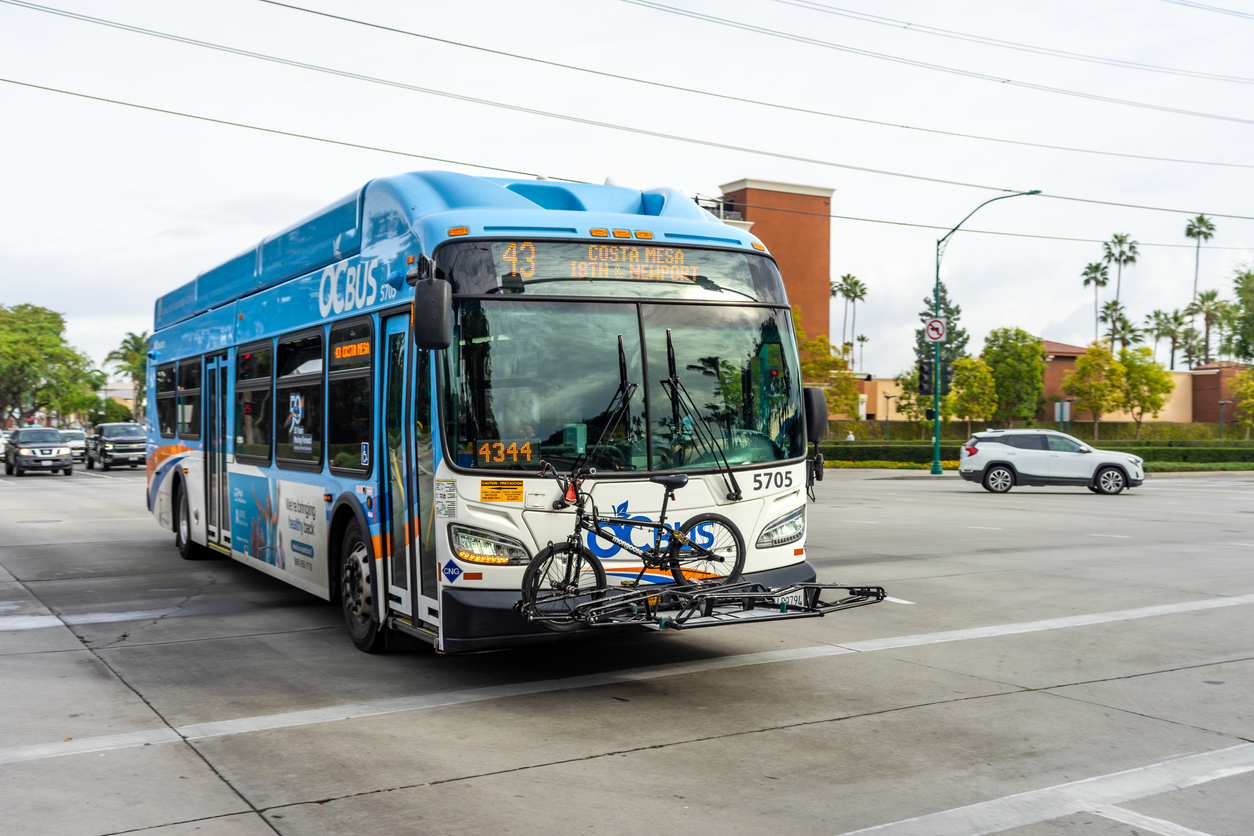
Across the United States and Canada, loading a bike on a bus is mainstream. Urban and suburban systems in cities including New York, Los Angeles, Chicago, San Francisco, Seattle, Toronto, Vancouver and Montreal almost universally fit a flip-down rack on the front of the vehicle, usually with two slots and sometimes three on longer buses or newer designs. By 2008, more than 70% of American transit buses had such racks, and today the vast majority of city fleets use them as a matter of course.
The process is designed for speed and simplicity. A cyclist lowers the rack, places the front wheel in a slot, secures the wheel or frame with a spring-loaded arm, then boards the bus. There is no reservation system and no extra charge in most cities. If the rack is full, the rider waits for the next bus, which is rarely more than a minor inconvenience outside peak hours. The hardware folds up against the bus when not in use and sits low enough not to interfere with the driver’s view.
The ubiquity of these racks makes mixed-mode commuting normal and has been credited with increasing public transport ridership among cyclists. Several North American rack designs would conflict with EU or UK construction and use rules if fitted as-is, whether because of length limits, lighting, crumple behaviour or pedestrian safety standards. Road widths, stop designs and procurement cycles also differ. Even so, the North American experience demonstrates that carrying bikes on buses can be done safely at scale.
Australasia
Australia
Adoption in Australia is uneven and determined at state or local level. Canberra stands out, with more than 90% of the city’s buses fitted with front-mounted racks that hold two bicycles. This is supported by a prominent Bike & Ride programme aimed at commuters who split their journey between saddle and seat, making Canberra the Australian city with the highest level of bike racks on buses.
In Victoria, selected routes in places such as Bendigo and some Melbourne suburbs have racks, indicating a willingness to expand where demand justifies the investment. A trial from 2016 to 2017 on routes including Essendon to Ivanhoe and Strathmore to East Coburg in Melbourne, as well as Bendigo Station to Strathfieldsaye and the Cowes to Wonthaggi route in South Gippsland, demonstrated that bike racks could operate safely on Victorian roads. Following the trial, the Victorian government approved broader rollout.
In New South Wales, including Sydney, regular buses do not carry full-size bicycles, and only folding bikes are allowed because of space and safety considerations. Similar restrictions appear in Queensland and South Australia, where attention has focused on allowing bikes on trains or ferries rather than buses. The overall picture is one of steady but patchy progress.
New Zealand
New Zealand has moved further and more consistently than Australia. From the early 2010s onwards, cities including Christchurch, Wellington, Dunedin, Nelson, Hamilton and Palmerston North began fitting front racks to public buses, often across entire fleets. Christchurch was an early adopter, and all city buses there now carry racks, with strong usage reported by both commuters and recreational riders.
The nationwide rollout encountered a setback in November 2024 when authorities suspended the use of front racks pending checks that they did not obscure headlights or otherwise breach vehicle regulations. The New Zealand Transport Agency issued an industry alert after concerns were raised that bike racks loaded with bicycles could partially obstruct headlights on some bus models, potentially making them non-compliant with road safety regulations. This was a precautionary step affecting cities across the country.
A working group comprising councils, public transport operators and transport agency officers was formed to find an agreed pathway to restore bike rack service. In April 2025, a daytime exemption was issued, and through May 2025, bus operators added LED lighting strips to bike racks and completed compliance checks. By mid-2025, bike racks were restored to full 24/7 operation in most regions after buses were modified to meet lighting requirements. The suspension lasted approximately six months, and whilst frustrating for cyclists, it was resolved without permanently removing the service.
Auckland, which had not previously adopted front-mounted racks, used this period to trial interior bike racks. From July 2025, 15 double-decker buses on the Northern Express 1 route (connecting Albany and the city centre via the Auckland Harbour Bridge) were fitted with interior racks holding two bikes each. This trial allows cyclists to cross the harbour bridge with their bikes, filling a significant gap in Auckland’s cycling network. Integration with the mobile app allows users to check in real time whether an approaching bus has a bike rack.
Across New Zealand, it is now common to take a bike on a bus without paying an additional fare, with the intention of supporting cycling as part of everyday mobility. The November 2024 suspension and subsequent restoration demonstrated the commitment to bike-on-bus services even when regulatory issues arise.
Practical Implications
Geography and governance shape what is possible. In Britain, Ireland and most of Europe, a folding bicycle remains the most reliable means of using buses as part of a longer trip. Enclosing the bike in a bag is not just courteous but often a condition of carriage. Where a full-size bicycle is involved, intercity coaches with underfloor bays offer the best chance, though availability should never be assumed. Fees vary, and space is allocated on the spot.
In North America and much of New Zealand, the expectation is that a bus will have a rack and that there will be no extra charge. Even there, capacity is finite, and riders remain beholden to the first-come rule if the rack is already full. Australia sits between these extremes, with Canberra leading the way and other cities gradually expanding provision.
The direction of travel is positive. Each year brings incremental progress as operators respond to demand for intermodal journeys and update fleets. The success of rear racks and trailers in Switzerland, the rear-mounted solution in Madrid and the spread of interior racks in Auckland all show that there is more than one way to solve the problem. Safety and legal compliance will continue to guide what is possible in each jurisdiction. For now, knowing the rules of the region you intend to visit and preparing a folding bike for easy carriage are the best ways to make bike-and-bus travel work smoothly in Britain and Ireland. Elsewhere, the growing presence of racks on buses has made mixed-mode trips far simpler, encouraging more people to ride to the stop, load the bike in seconds and continue their journey with minimal fuss.
Germany’s choice to prioritise reach over pure speed sits within a broader European landscape of railway models, each shaped by different priorities and constraints. Comparing how neighbouring countries organise and fund their networks helps explain why punctuality, speed and passenger satisfaction vary so widely across the continent, and why solutions that work in one setting do not always translate to another.
Dedicated speed versus mixed traffic
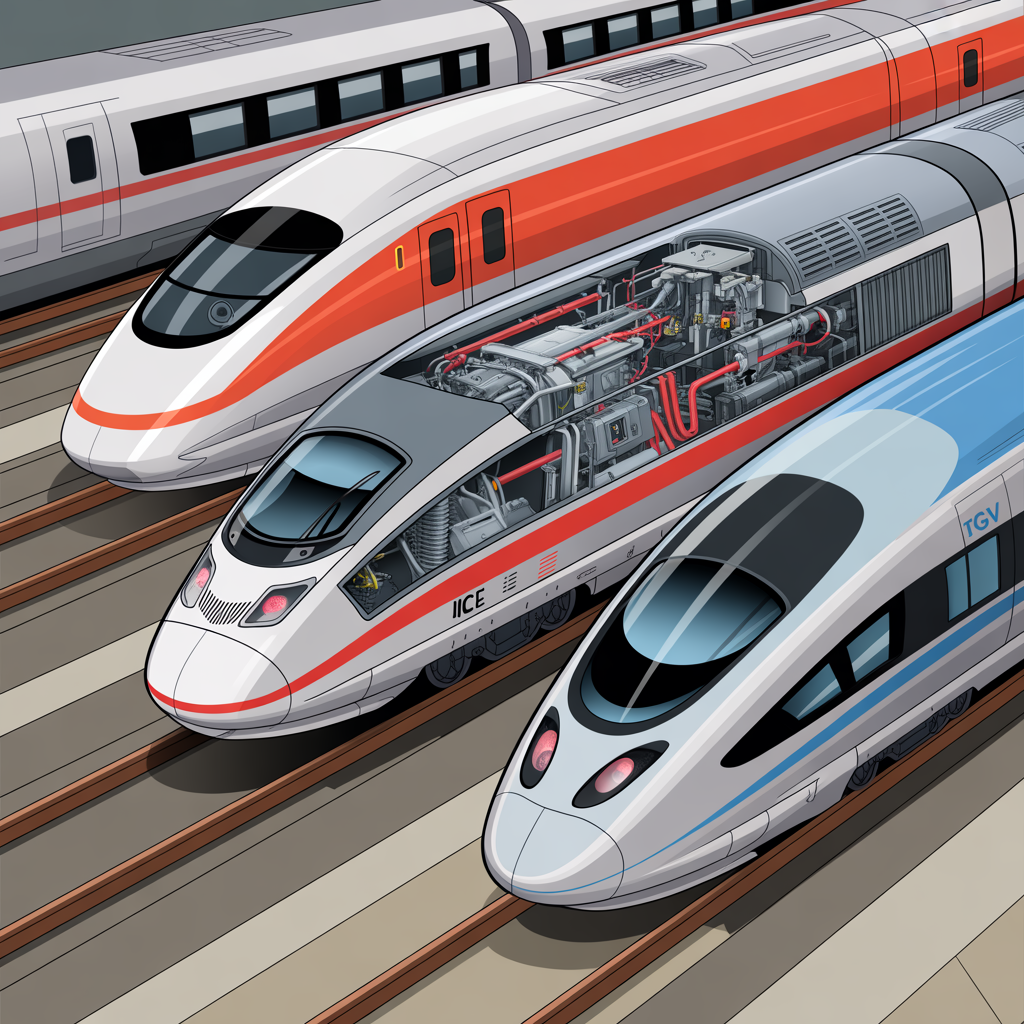
France built a TGV system that separates most high-speed travel from conventional traffic, achieving punctuality around 90% and average speeds of 200 to 230 km/h between major cities. The network remains strongly centred on Paris and cross-country trips can be awkward, but the dedicated lines deliver consistency. Germany wove high-speed sections into existing corridors, allowing ICE trains to share track with regional services and freight. The result is broader coverage but lower reliability, with long-distance punctuality at 62.5% in 2024 compared to regional trains at 90%. The structural difference is stark. France sacrificed some connectivity for speed and precision, Germany chose the opposite and lives with the trade-offs.
Precision through discipline
Switzerland manages an intensely used network with remarkable precision, rarely exceeding 200 km/h yet achieving punctuality around 93% through robust timetabling, reliable connections and continuous small improvements rather than spectacular new lines. The model depends on meticulous planning, generous buffers and a culture of incremental refinement. Trains coordinate across operators and modes, connections are protected and delays are contained before they cascade. The Swiss approach works because the network is smaller, the topography forces discipline and investment has been sustained over decades. Germany’s scale and mixed-traffic complexity make direct replication impossible, yet the principle of building slack into timetables and prioritising reliability over maximum frequency resonates.
Austria keeps infrastructure and operations within a public group, allows open-access competitors on key corridors and maintains punctuality close to 90% with steady investment. The structure resembles Germany’s, but the network is smaller and less congested, allowing tighter control. The Netherlands runs a state infrastructure manager with a dominant national operator, achieving punctuality above 90% despite limited top speeds and very high usage per kilometre of line. Intensive use is managed through careful coordination and a willingness to invest in capacity at pinch points. Both countries show that public ownership does not guarantee outcomes, execution matters more than structure.
Transitions and compromises
The United Kingdom is creating Great British Railways to bring planning, fares and timetabling back under public control, with long-distance punctuality commonly between 85 and 90%, top speeds of 200 km/h on upgraded lines and true high-speed services waiting on the delayed HS2 project. The shift reverses decades of fragmentation and acknowledges that splitting infrastructure from operations created coordination failures.
Norway and Sweden use public infrastructure agencies and a mix of public service contracts and open access for operators, targeting reliability and cost control with long-distance punctuality typically in the high eighties. The Scandinavian model balances public accountability with competition, though sparse populations and long distances limit direct comparison with denser networks further south.
Switzerland has committed substantial funds for ongoing maintenance and expansion through programmes like the 2035 Rail Expansion Step, while Austria maintains a multi-billion euro infrastructure plan. Germany’s totals are enormous in absolute terms, yet when spread across a vast and ageing network they do not immediately translate into the reliability seen in smaller systems.
Usage intensity plays a part as well. The Netherlands and Switzerland record very high passenger train-kilometres per route-kilometre each day and still perform well, but Germany’s mixed traffic shows its strain in freight figures alone, with around 19 freight train-kilometres per route-kilometre per day in 2022 on parts of the network. Add tens of thousands of daily passenger trains and the room for recovery reduces when something goes wrong.
Structural differences in practice
Comparisons between similar-length journeys underline the structural differences. London to Edinburgh is roughly 640 km by rail and can be as quick as four hours ten minutes on the East Coast Main Line using 200 km/h trains, with high reliability by European standards. Munich to Hamburg is longer at about 800 km and comes in close to six hours despite a higher top speed, because the line weaves through mixed-traffic sections and slows for approaches and junctions. Rail remains city-centre to city-centre in both cases and offers a strong alternative to flying. The British route benefits from a simpler set of operating constraints and a service design that holds top speed for longer stretches. The German route serves more intermediate markets and lives with the compromises that entails.
Lessons and limits
The comparison reveals no single formula for railway success, but it does highlight patterns worth noting. France demonstrates that dedicated infrastructure delivers speed and reliability but requires political will to bypass intermediate markets and accept a Paris-centric network.
Switzerland proves that precision is possible without high speeds if discipline, coordination and sustained investment are maintained across decades. The Swiss model succeeds in part because scale allows tighter control, topography enforces careful planning, and the political consensus supports continuous funding.
Austria and the Netherlands show that smaller, well-funded networks can achieve consistency even with mixed traffic, though neither faces the sheer volume and complexity of Germany’s system. The United Kingdom illustrates that structural reform is not a quick fix and that legacy fragmentation takes years to unwind, with coordination challenges persisting even under renewed public oversight. The Scandinavian approach balances public accountability with market competition, though sparse populations and long distances create different dynamics than in densely populated Central Europe.
Germany’s challenge is unique in scale and complexity. The network serves more places, handles more freight and faces higher usage intensity than most European neighbours. Yet the examples that surround it suggest that closing the punctuality gap will require not only the massive infrastructure renewal now underway but also operational discipline, timetable redesign and a willingness to prioritise reliability over frequency where capacity is constrained. The €107 billion programme addresses the hardware, and the corridor modernisation strategy targets the most critical bottlenecks. The culture and coordination that turn investment into performance, however, remain works in progress.
What becomes clear from the European comparison is that Germany cannot simply adopt the Swiss model, replicate the French approach or follow Britain’s path. The network’s size, the freight integration, the federal structure and the post-reunification geography all impose constraints that other countries do not face. The question is not whether Germany can match Swiss precision or French speed in the abstract, but whether the current programme can deliver meaningful improvement within Germany’s specific context. The answer will emerge over the next decade as the corridor modernisations progress, the digital signalling expands and the renewed infrastructure comes into full use. Until then, the gap between aspiration and reality persists, and travellers continue to navigate a system caught between its ambitions and its constraints.
From October 25th, Bus Éireann is introducing revised timetables for its Expressway Route 13 and Route 14 services, which operate between Limerick, Tralee and Killarney. The changes aim to improve reliability and punctuality by adjusting departure times according to traffic conditions. A new Sunday morning departure from Tralee to Limerick has been added, and some weekday and Sunday journeys have been withdrawn. Discounted online fares are available until the end of November and customers are encouraged to book tickets in advance to secure their seats.
18:47, October 9th, 2026
The National Transport Authority, in partnership with Clare County Council, has introduced a new Ennis Town Bus Service, which will begin operating on 18th October 2026 as part of the Transport for Ireland network. The service includes two routes, NS1 and NS2, connecting key areas of Ennis such as the town centre, Ennis Hospital, Ennis Bus and Rail Station and surrounding residential areas. Both routes operate every 30 minutes throughout the day, with a 15-minute frequency along a shared central section and run from early morning until late at night.
The buses are low-floor, fully accessible and high capacity. Standard fares apply, with discounts available for Leap card users and free travel for certain groups. This development is part of the NTA’s Town Bus Programme, which seeks to provide sustainable and accessible public transport in regional towns across Ireland.
 Posted on November 21st, 2025