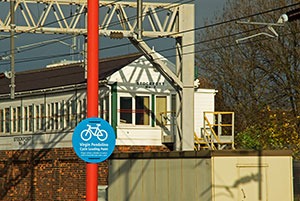
Yesterday, I set down my observations and thoughts regarding the carriage of bikes on buses. Perhaps naturally, my thinking has taken me into the area of carrying bikes on trains. On paper, that’s an easier proposition because most trains have some space set aside for bicycle storage. You may need to pay extra for carriage with a long-distance express operator (Virgin Trains, for example) but it is included in the walk-on ticket price for most operators. The exceptions to this usual level of provision are some commuter services in the southeast of England where you have to sneak on folding bikes as luggage, a draconian state of affairs in my opinion.
Mind you, carrying any bike on a busy train is not the easiest thing to be doing. That’s what I faced when I needed to convey one from Skipton to Macclesfield in 2000. Thankfully, an obliging Northern Spirit train conductor allowed me to carry it on even when there were bikes already on board and the DMU, like many, had only two spaces. Then, there was getting around Leeds station. There are lifts there now but this was before the major refurbishment that gave us what we see today and you needed a helpful station attendant to take you around use goods lifts and shop workers neglected to close the doors after them and the lift at platform level with us on the bridge! That made an already involved exploit a little more anxious than was needed. Saying that, I still caught my train to Manchester and another to Wilmslow due to rail engineering works. The Manchester changeover must have passed off with no trouble because I have no memory of it but getting from Wilmslow to Macclesfield involved a man with a very large taxi, a Ford Granada/Scorpio estate. If that wasn’t there, things would have been far more tricky.
That whole episode captures quite a few of the challenges that you have to overcome to get anywhere on the railways with a bike in tow. If there are engineering works, then you could be facing the obstacle that is the non-carriage of bicycles on buses or coaches. Even if there aren’t, there’s getting around train stations and Leeds is now both brighter and easier to get around than it use to be. Nevertheless, ticket barriers have been added and they are a new obstacle to be overcome that isn’t exclusive to Leeds since their use is spreading in the U.K. and beyond with Dublin’s Heuston Station now having them in Éire; thankfully, a certain amount of presence of mind has given us wide gates for those carrying wide articles with us. Finding space on a train is an ever-enduring issue and might be one that is never resolved completely. In fact, modern trains have been getting less good at conveying luggage anyway, so much so that Virgin try to encourage you not to bring along too much; it is best not to attempt moving house by train then unless your worldly goods are none too numerous, not a situation in which I find myself anymore.
All in all, you can take a bike around with you on the next parts of Britain’s railway network though there’s a spot of extra effort needed. It isn’t simply a matter of grabbing your bike and jumping on a train for a day out in the country. After a busy week of work, that may be sufficient to make you go for a walk instead and that’s partly how I got into hillwalking; the fear of punctures and mechanical failure hasn’t helped either. For a longer trip away or moving home to take up a new job like I was doing in the story above, the effort is worth it and does work. It just needs planning and patience rather than spontaneity. After all, the temptations of car use of bicycle hire are ever-present too.
I remember making a return journey between Charleville and Cork in Ireland when a passenger just popped a bicycle into one of the coach’s side lockers and it was carried without further ado. When I had the idea of doing the same on an outing from Edinburgh to Fort William, I was thwarted because carriage of bicycles on buses and coaches is not the norm. The phrase that lingers in my memory, regardless of whether it actually was said that way or not was “This is not a train”. Undeterred, I secured my bicycle and left it after me to enjoy a wonderful day out. The change of plan was no spoiler though the it did alter how I spent the day.
There are some who might say that the above contrast between Irish easygoing helpfulness, the same type that allows the carriage of forgotten luggage on a service coach from Galway to Dublin without charge or facilitating the retrieval of a case left on Dublin’s LUAS tram system by myself and I half-asleep after an early morning flight from Manchester, and British adherence to process and procedure. While I cannot doubt Irish helpfulness, I am more inclined to attribute the differences in outcome to differences in legal systems.
Whatever the cause, non-carriage of bikes by buses and the paucity of accommodation for them on trains (a story for another time) has fostered the growth of my interest in hillwalking at the expense of cycling. Ironically, it is in the types of places where I go walking that there have been innovations when it comes to carriage of bicycles by buses. In the Yorkshire Dales, trailers have been attached to Dennis Darts for the purpose. In other places, you see the use of racks mounted on the back for the same purpose and the X94 that goes between Chester/Wrexham and Barmouth comes to mind but there are others. Having bicycle pens within the buses themselves is another way of achieving the same and I have vague recollections of this being done in Snowdonia and the northwest of Scotland. On the subject of vague recollections, I have another one of seeing a photo in Buses magazine where seats have been replaced by a place to put bikes on what appeared to be a double-decker.
Though none of those ways to carry bikes on buses are widely available, there is an argument in favour of making that happen. After all, having a bicycle in a wheelchair or buggy space on a low floor bus is likely to cause a nuisance and you couldn’t even get one on the older step entrance vehicles. Then, there’s the prospect of breaking up a bike to carry it on a National Express coach service and that sounds like something that you would do if you were carrying one on an airplane. Of course, there are those folding bikes that people sneak onto commuter trains at peak times as luggage but is that really ideal for that day out in the countryside exploring its quieter roads? All in all, it’s a state of affairs that encourages car use but remains a tough nut to crack whichever way you go about it.
All this talk about the cutting of public spending does cause one to wonder about where the axe will fall and what effect will be felt by public transport. It might be that rather than being detached service users, we might need to have more of a helping hand in its provision. After all, it wouldn’t be without endless campaigning that the likes of the Settle-Carlisle railway line survived and we may need to brace ourselves for what we find ahead of us. Speaking of that railway, its supporters do contribute to the upkeep of train stations along the route, some of which were closed at one time. On a wider scale, community rail partnerships have their place and that looks certain to stay with the spectre of spending cuts looming in out futures.
That level of community support of the railways, especially rural ones, has made me wonder about the same for our bus network. This becomes more pertinent when you see smashed up bus shelters like the one that I saw in Heaton Chapel last Saturday or the when bus service information boards attract the attentions of the bored (graffiti and cigarette burns are a particular nuisance). Extending this further, some shelters need a general clean and that only can help to make bus travel more appealing. Even in times when tax revenues were higher, a quick look around often proved that the state could not be everywhere and CCTV systems are not a substitute for local human action. That will become more so if the U.K.’s public sector debt is to be reduced from its current level. The result of this thinking is that I get to wondering about adopting a local bus shelter and keeping an eye on it, maybe even giving it a clean every now and then. It seems that no one else has had the brainwave so I’m sticking it out on the web to provoke perhaps a little thought. Maybe, if we all kept an eye on things, then we might save some of the cash that is spent on righting the results of moments of drunken and bored madness or even give rise to the idea that bus shelters are not mere infrastructural outposts but are part of a given community. Admittedly, this is blue skies thinking but, without a bit of that, where would we all be right now? After all, a bit of civic mindedness can make a real difference to an area.
One of the things that amazes me about Cheshire is where you can find footways and traffic lights. Sometimes, these are as far from dense urban areas as you can hope to get. The traffic lights at Bosley Crossroads are typical of the type as perhaps are those at Monk’s Heath. That’s never to say that they are not needed but it is telling how dense traffic can get on Cheshire’s roads at times that even rural locations are afflicted by the malady.
On the other hand, it can amaze one where there aren’t any traffic lights either. For example, having one at the junction of Green Lane and Alderley Road (A538) in Wilmslow would surely help the 130 on its way to Macclesfield during the rush hour. The possibility that really comes to mind is the staggered junction between Priory Lane, Macclesfield Road (B5087) and Prestbury Road near between Upton Priory and Prestbury. I was reminded of this twice when come home from work on my bicycle because with busy filter lanes, someone could take a chance when they shouldn’t and anyone on a pedal cycle cut come off badly as a result. The Connect 19 passes the way too so visibility mightn’t always be what it should be. Of course, you should never pull out of a minor road onto a major one when you cannot see what’s happening but we all can make mistakes, can’t we? It’s not a particularly nice part of the road system of a dark evening or morning so I often wonder if anyone does come a cropper around there.
There are times when we get to wondering how much better things might be if history had turned out differently. Of course, it always could have turned out worse too so we need to be careful with our wishful thinking. In that vein, sticking with change the present for the better rather than wishing that the past was different is the better path to be taking.
What has taken me down this train of thought is the sight of an unused viaduct in Ingleton over the weekend. Until 1954, there was a railway line that served places like Ingleton and Sedbergh and the path that it took eerily shadowed the Settle-Carisle (Ribblesdale) line. In fact, that should never have needed to be built but for a dispute between two railway companies disrupting passenger travel arrangements and Ingleton’s viaduct was at the heart of the dispute, so much so that passengers needed to walk from Ingleton to Thornton-in-Lonsdale and there a railway connection between them! Just imagine if you will what the uproar this would generate today.
The outcome of all this was that the Ingleton-Sedbergh (Lonsdale) line became diminished in status with the Ribblesdale one taking over and surviving all attempts to close it (there were a few but it looks secure for now). In the former’s heyday, 6,000 folk descended on Ingleton of a day to wandering by its waterfalls. Mercifully, it’s a much quieter spot now and provides generous respite from the madness of modern life. If the Ribblesdale line never existed, the Lonsdale line might have survived and become the way to get to Yorkshire’s Three Peaks. You only can imagine how isolated places like Horton would feel with occasional bus services being the sole means of getting there; it could have made the Pennine Way feel so much more wild than it does. The Wensleydale line might still be there to allow trains to travel between Leeds and Carlisle via the East Coast Mainline.
All of this theorising might seem pie in the sky thinking but it’s decent fun to do stuff like this without taking it seriously and it allows an escape from the strictures of modern living for a little while too. It all goes to show how the non-existence of something bequeathed to us by history, even a single train line, can cause things to be so different. Taking out the Settle-Carlisle railway would have us going around by Lonsdale or Wensleydale rather the routes that we actually do take to get to immerse ourselves in peaceful countryside.
From October 25th, Bus Éireann is introducing revised timetables for its Expressway Route 13 and Route 14 services, which operate between Limerick, Tralee and Killarney. The changes aim to improve reliability and punctuality by adjusting departure times according to traffic conditions. A new Sunday morning departure from Tralee to Limerick has been added, and some weekday and Sunday journeys have been withdrawn. Discounted online fares are available until the end of November and customers are encouraged to book tickets in advance to secure their seats.
18:47, October 9th, 2026
The National Transport Authority, in partnership with Clare County Council, has introduced a new Ennis Town Bus Service, which will begin operating on 18th October 2026 as part of the Transport for Ireland network. The service includes two routes, NS1 and NS2, connecting key areas of Ennis such as the town centre, Ennis Hospital, Ennis Bus and Rail Station and surrounding residential areas. Both routes operate every 30 minutes throughout the day, with a 15-minute frequency along a shared central section and run from early morning until late at night.
The buses are low-floor, fully accessible and high capacity. Standard fares apply, with discounts available for Leap card users and free travel for certain groups. This development is part of the NTA’s Town Bus Programme, which seeks to provide sustainable and accessible public transport in regional towns across Ireland.
 Posted on November 5th, 2009