Exploring Milan and Nearby Alpine Lakes by Rail and Ferry Services
 Posted on August 6, 2026
 Reading time: 6
minutes.
Reading time: 6
minutes.
In May, attendance of a conference carried me to Milan for my first ever visit to Italy. While the conference would take up most of my time, there were opportunities for explorations too. Mainly, these were around the city itself with Parco Sempione, the Duomo featuring as well as Naviglio Martesana and other city canals. That was not all for I also got to Lago Maggiore and Lago di Como, gaining me some alpine vistas and getting me out of the city too.
Getting Around Milan by Metro
Metro trains operated by ATM got me around Milan seamlessly. Though there is an app, and you can pay by that means, using your bank card to tap in and out is all the more convenient. Saying that, buying day passes might prove more cost-effective, which is something that the app will do for you as well as giving updates and alerts on any service changes due to such things as industrial action or the effects of major events in the city.
Because I arrived into and departed from Linate Airport, I made use of the M4 line, an automated affair with no drivers on board the trains and central oversight to ensure that all is well. That did not get me all the way to my hotel though, so I changed onto the M2 line at San Ambrogio to get nearer, leaving a short walk for the rest of the distance from the nearest station. That connection needed a longer walk between the M4 and M2 than one might have expected; the feel was like going between two different systems, with the M4 line being the newer of the two.
The more conventional human driven line M2 was to see a lot of me during my stay, though I also used line M1 at times to reach the Duomo and also the Naviglio Martesana for one evening stroll. The whole system worked well throughout my stay, without any intrusion from industrial action or a Sunday evening AC Milan celebration when some stations were closed for crowd safety. It helped that line M2 also connects with Milano Centrale, which was a boon for getting out of the city to those aforementioned alpine lakes. Metro stations have handy vending machines offering refreshments too, which have their uses when shops are not so convenient.
Experiencing Italian Regional Rail
My hotel may have been near Romolo station, yet I chose not to use the regional trains that stopped there, opting instead to use it solely for the Metro M2 line. The latter got me to Milano Centrale anyway, which gave me vastly more choice.
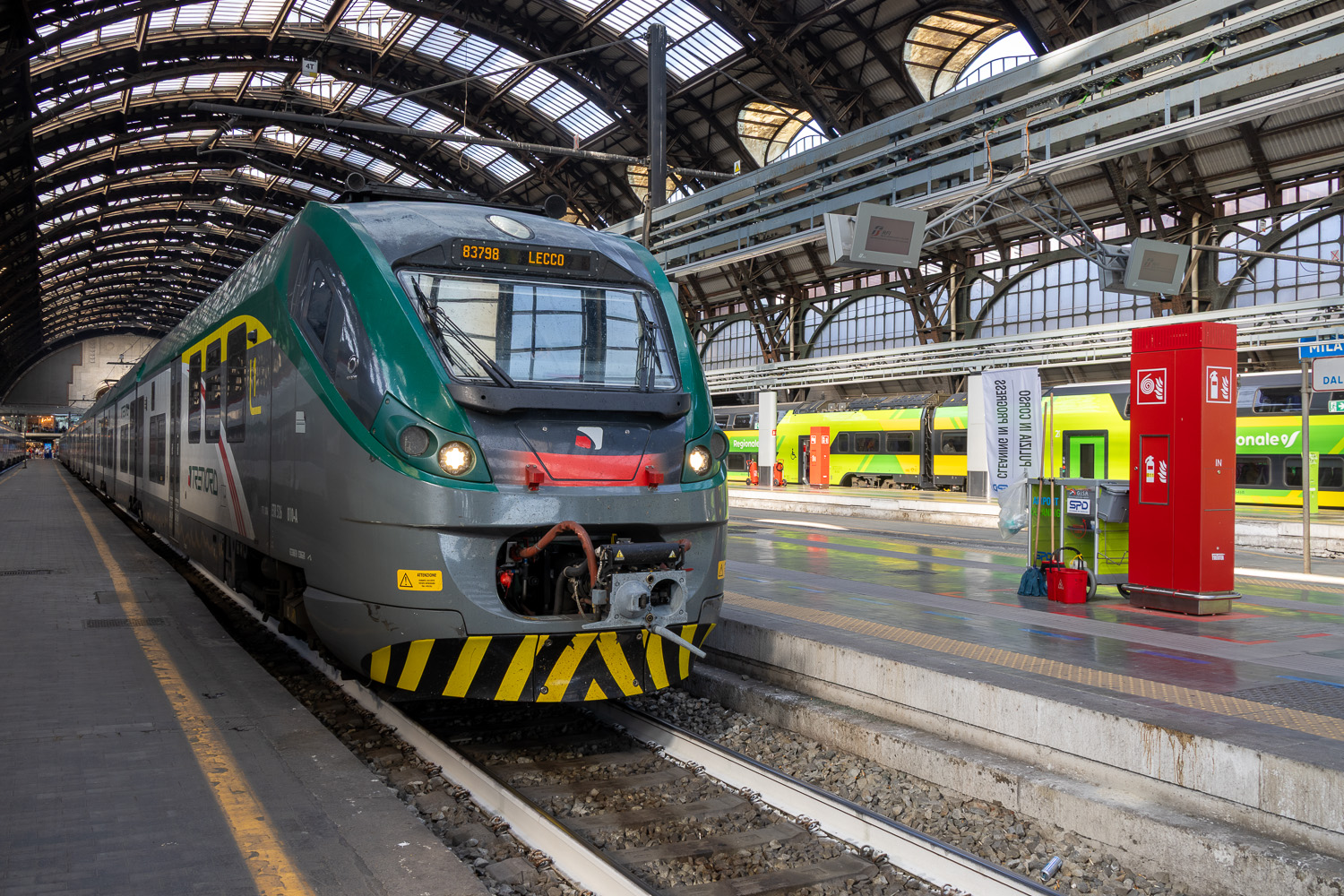
However, my first approach to Milan’s main train station was on foot in fading light. It looked an astonishing sight to someone accustomed to plainer buildings arranged around train sheds if anything. This expansive building has several floors and offers a plentiful range of food and retail options. Naturally, it is a busy place and an architectural marvel in itself, later guaranteeing a return with more daylight to do it more photographic justice.
Reaching Stresa on Lago Maggiore
Though there are high speed departures from Milano Centrale offered by Trenitalia under its Frecciarossa brand as well as Italo, a privately operated competitor, these did not take me where I wanted to go, so I made use of Trenord regional services. The first excursion using these took me to Stresa on the western shore of Lago Maggiore.
Getting a ticket took some doing though because the Trenord app did not always help, even if the Trenitalia counterpart did better and completed the task. Also, buying a ticket at a train station laden with Italo machines meant care to find the Trenitalia ones, which sometimes took its share of effort. All in all, it pays to take time to get oriented.
Beyond that, the main cause for concern with that experience was the announcement of a national strike to run from 21:00 that evening until 21:00 the following day, though there were guaranteed rush hour train services for those who needed them. That did not include me, so this curtailed my time around Lago Maggiore and put paid to any ambitions of hiking from there to Belgirate, probably a good idea given it would have had me leaving Stresa prematurely in any case.
Otherwise, the out and back journey was uneventful save for a delayed arrival and ample sightings of graffitied trains, an all too common occurrence in Italy compared to other places. Still, the journey was comfortable, and the double-decker carriages were far from overcrowded. Getting back to Milan well before the strike started made for a calmer state of mind too.
Making Crossings of Lago di Como
If my trip to Lago Maggiore was limited by a train strike, the one to Lago di Como had its own set of challenges. The first was that I only could get as far as Lecco by train before changing onto rail replacement coaches, the most chaotic such transfer in my life and one that I had not expected either. This was a badly managed situation with staff taking charge later than was ideal. Having nearly tripped on an unseen step did not help either, though I mercifully avoided crashing into someone else.
Thankfully, I still got to Varenna as I had hoped, which set me up for a day of lake crossings using the services of Navigazione Laghi. These proved to be smoother than my outbound journey from Milan as I got to Bellagio and Menaggio on single tickets before getting back to Varenna again. While day tickets are available, I was unsure of my itinerary and three single tickets were a euro cheaper anyway. All in all, this was a day with much strolling, albeit with the heat taking its toll on me at one point. Given that, it was just as well that I shelved thoughts of hiking the Greenway del Lago di Como, making this a prospect for any return visit.
The return to Milan was a crowded affair with many standing for much or all of the way. That included me until Monza after which the train became much less busy. The fine weather had lured out so many that even the long trains with double-deck carriages became packed. It also seemed that only one track was in use in both directions around Varenna, which cannot have helped to boost frequencies.
Collected Impressions
While my experiences with Trenord were a chequered lot, those with ATM metro trains were as solid as those of Navigazione Laghi ferry services. My not having much Italian was no limitation, especially with apps using English on my phone. Orienting oneself did not take so much effort either, a bonus on a visit that was just around a week in duration. All could be handy if a follow-up visit ever comes to pass.
Recent Musings
October 2026 Wirral Bus Network Changes Under Liverpool City Region Franchising
West Cork Bus Connections for Walkers and Other Visitors
Planning County Kerry Walks and Day Trips by Bus
Discovering County Mayo Using Public Transport
Appraising Bus Routes for a Car-Free Walking Trip in Donegal
Extras & Utilities
Carrying Bicycles on Buses in Britain and Ireland
Not Just Blogs, A Collection of Public Transport News Sources