From Navan to Belfast, Irish Rail Improvements Continue to Take Shape
 Posted on May 28, 2026
 Reading time: 11
minutes.
Reading time: 11
minutes.
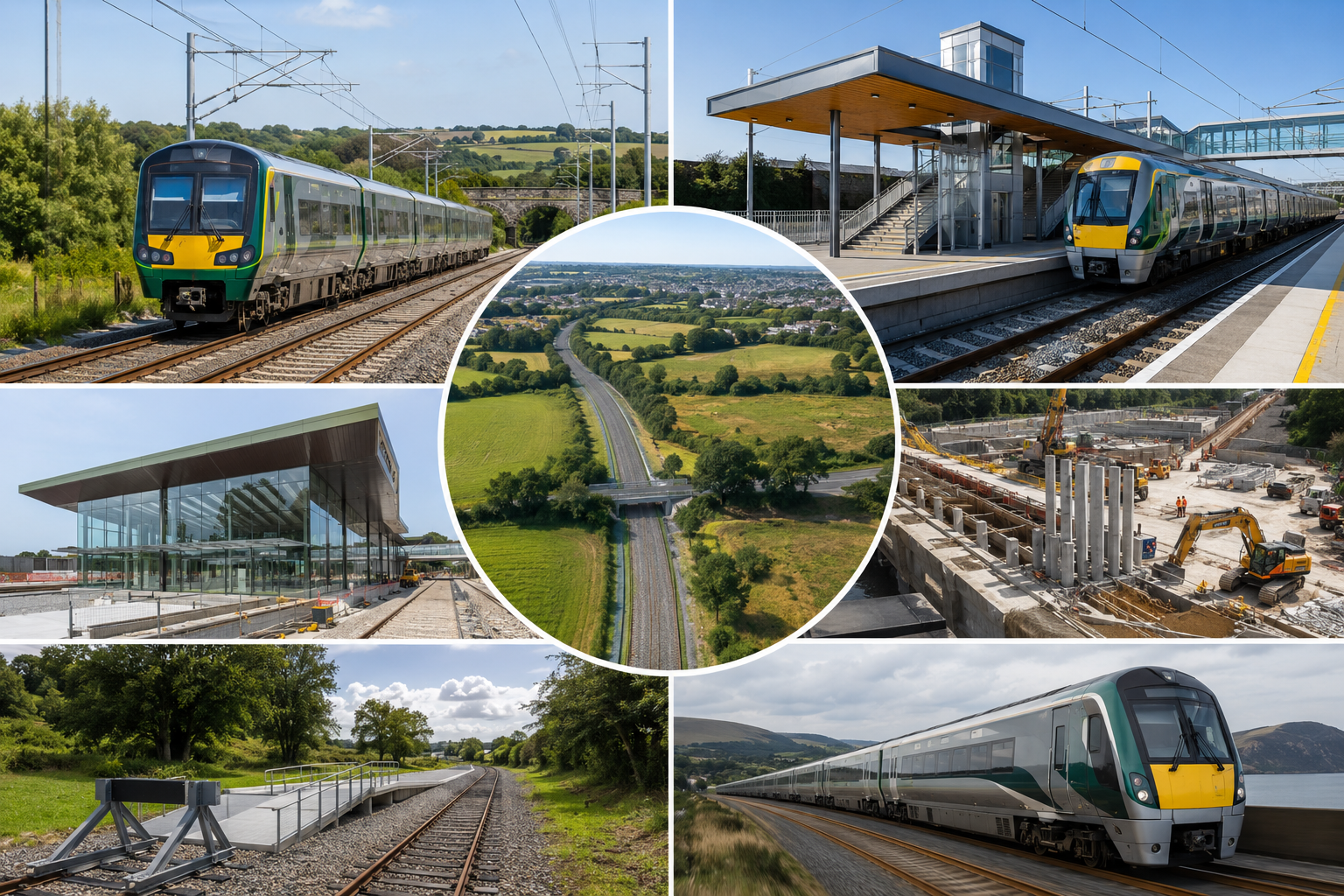
A previous article on this site examined how Iarnród Éireann’s investment programme was enhancing the rail network across Ireland, covering work under way in Galway, Waterford, Limerick and Cork. Since that was published in April, a further wave of announcements has followed, adding new detail to some of the schemes already discussed and introducing several significant developments that were not yet in the public domain at that point. All of that is the subject-matter for what you find here.
Starting with County Meath, the Emerging Preferred Route for the Navan Railway has been published, and a public consultation has opened. In Cork, the second round of public consultation on the next phase of the commuter rail programme has launched, while two early stations at Blackpool and Dunkettle have moved into the planning process. Moving to Galway, Oranmore station’s main construction contract has been awarded, and Ceannt Station has reached a visible new milestone. Further west, work has started on a temporary station at Adare for the 2027 Ryder Cup, tied to the reinstatement of the Limerick to Foynes Freight Line. And at a cross-border level, the contract for a new Enterprise fleet between Dublin and Belfast has been formally signed.
The Navan Railway: A New Route Takes Shape
Emerging Preferred Route
The proposed return of rail to Navan is among the most consequential of the new announcements. Iarnród Éireann has published the Emerging Preferred Route for a new 34-kilometre electrified railway extending the existing line from M3 Parkway to Navan. The scheme would bring direct DART services to what is described as the largest town in Ireland not currently on the passenger rail network. New stations are proposed at Dunshaughlin, Kilmessan, Navan Central and Navan North, with the line terminating at Navan North.
The service pattern outlined is ambitious. Trains could run as often as every 15 minutes at peak times between Navan and Dublin Connolly, with an end-to-end journey time of approximately 60 minutes and capacity for up to 4,400 commuters each way per hour. Three park-and-ride sites are planned at Kilmessan, Dunshaughlin and Navan North, indicating the line is intended not only for the towns directly on its route but also for a wider commuter hinterland across County Meath.
Policy and Funding
The project is funded by the Department of Transport through the National Transport Authority and sits within the Greater Dublin Area Transport Strategy. It aligns with the National Development Plan Review 2025, the Climate Action Plan 2025 and the All-Island Strategic Rail Review, as well as the Meath County Development Plan. In practical terms, the railway is presented as a means of connecting growing communities to the wider public transport network and encouraging a shift away from private car use.
There is also a historical dimension to the project. The preferred route broadly follows the old railway alignment that was lifted from 30th March 1963 onwards, making use of the disused corridor where possible. One significant revision has been made, however: a change in alignment to better serve Dunshaughlin and its surrounding area, which emerged from the route selection process and reflects how commuting patterns and settlement growth now shape railway planning in a way that was not a consideration when the line was originally closed.
Public Consultation
Public consultation on the Navan Railway opened in May 2026 and will run until 17:00 on Friday 3rd July 2026. This is the first of two non-statutory consultations and presents the Emerging Preferred Option for the project design. Iarnród Éireann has stated that input from communities, residents, businesses and other stakeholders will inform the design before a Preferred Option is identified. Consultation events are being held in Navan, Dunshaughlin and Kilmessan, with an online webinar also available. Full details and a feedback form are at irishrail.ie/navan-line.
Cork: Phase 2 Consultation Opens and Two Stations Enter Planning
Background
The Cork Area Commuter Rail Programme was covered in some depth in the previous article, which examined Phase 1 in detail, including the new Kent Station through platform, the Glounthaune to Midleton twin-track project and the signalling and communications upgrade. Since then, the focus has shifted to Phase 2, which sets out the proposals for new stations, a new depot and full electrification of the Cork rail network.
Second Public Consultation
The second public consultation on the Preferred Option for Phase 2 of the Cork Area Commuter Rail Programme has now opened, running from 15th May to 12th June 2026. This phase is intended to deliver the remaining infrastructure needed for trains to run up to every 10 minutes on each of Cork’s three commuter lines to Mallow, Midleton and Cobh. The consultation covers six additional stations at Blarney, Monard, Tivoli, Ballynoe, Carrigtwohill West and Water-Rock, as well as electrification works, overhead line equipment, substations, construction and maintenance compounds, access to the proposed depot at Ballyrichard More and interventions to existing structures. Station upgrades at Cobh and Mallow are included, alongside a strategic park-and-ride site at Blarney and a further park-and-ride at Dunkettle.
Once this consultation closes, the project team will analyse submissions and a non-statutory findings report will be produced. A Railway Order application will then be submitted to An Coimisiún Pleanála in late 2026, at which point a statutory consultation process will follow. Consultation events are taking place across the city and county, including at Kent Station, Cobh, Carrigtwohill, Blarney, Midleton and Mallow, with a webinar also available. Further information is at irishrail.ie/cacr.
Blackpool and Dunkettle Stations Enter Planning
Alongside the broader consultation, two of the eight proposed stations are being progressed more quickly. Iarnród Éireann has published its intention to lodge a planning application for Blackpool Station, with Dunkettle to follow within weeks. Both are being taken forward via separate Section 34 planning applications to Cork City Council and Cork County Council respectively, ahead of the wider Railway Order. They are being progressed on existing Iarnród Éireann land, which provides scope for earlier delivery, with construction expected to begin in 2027 and take up to two years, subject to planning approval and funding allocation.
The proposed Blackpool Station would be located near the historic station site, bounded by Dublin Hill Road and Redforge Road, with two platforms linked by a pedestrian footbridge incorporating stairs and accessible lifts. The station is intended to support regeneration in the Blackpool area and would initially be served by up to 10 trains daily, with scope for service increases once the wider programme is complete. Dunkettle, by contrast, is being positioned as a strategic park-and-ride station near the interchange of major roads including the M8 and N25, served by both the Cobh and Midleton lines. An initial 15-minute service is envisaged, with a 300-space park-and-ride facility planned and room for expansion if demand warrants it.
Galway: Main Works Begin at Oranmore and Ceannt Reaches a New Stage
Oranmore: From Enabling Works to Construction
The previous article explained the background to the Oranmore Station project: the Athenry to Galway line is currently single track with no opportunity for trains to pass each other in opposite directions, and the planned one-kilometre passing loop and second platform are designed to remove that constraint and double services to every 30 minutes in each direction. Enabling works have been completed, including the installation of a new pedestrian and cycle underpass in October 2025.
The main construction phase has now been awarded. The contract has gone to Triur Construction, with works expected to begin in May 2026 and to finish in late 2027. This phase will deliver the new 185-metre platform to the north of the existing one (accessed via the underpass), the 1-kilometre passing loop, a bridge deck replacement and associated station infrastructure including a lift, access ramp, stairs, shelters, help points, passenger information signs, lighting, CCTV and seating. From 18th May 2026 to summer 2027, some station parking spaces will be affected during the works, though train services are expected to continue as normal throughout.
Ceannt Station: A Visible Milestone
Ceannt Station in Galway city was also covered in the previous article, which described the scale of its redevelopment: five platforms replacing two, a new southern entrance and façade, an upgraded train hall roof and accessibility improvements throughout. From the morning of Saturday 18th April 2026, the southern side of the station became the main point of entry and exit for customers, with ticket validators entering operation there.
Adare and the Foynes Line: Freight, Events and a Temporary Station
The Ryder Cup Station
The Limerick to Foynes Freight Line reinstatement was mentioned briefly in the previous article, but it has since moved to the foreground with a related announcement. Work has begun on a temporary station at Adare to support the Ryder Cup, which takes place at Adare Manor in September 2027. The temporary facility will consist of a platform and external concourse, at a cost of approximately €3 million, and is expected to take six months to build. It is being delivered by Cara Plant Hire Limited and funded by the Department of Transport through the National Transport Authority.
Special Ryder Cup rail services are planned to run as a shuttle between Limerick Junction and Adare on the reinstated Foynes line, likely outside regular timetable hours and using existing rolling stock. Passengers from Dublin and Cork would change at Limerick Junction, with the service intended to move thousands of spectators to and from the event each day. That arrangement gives a temporary passenger use to infrastructure being reinstated primarily for freight, making effective use of work already under way for a different purpose.
The Foynes Freight Line
The €151.5 million Limerick to Foynes Freight Line project involves the reinstatement of 42 kilometres of track, the closure and upgrading of user-worked level crossings, the installation of signalling and telecoms systems, the full refurbishment of Foynes Station building and train shed roof, reconnection to the network at Limerick and the reinstatement of 13 public road level crossings with CCTV-monitored crossings. Track-laying was completed in 2025 and systems work is continuing, with the line due for commissioning in October 2026. Driver route training will follow, with freight services expected to begin in early 2027. The project forms part of Iarnród Éireann’s Rail Freight 2040 Strategy and its partnership with Shannon Foynes Port Company.
The New Enterprise Fleet: Contract Formally Signed
The Agreement
Perhaps the most headline-generating announcement of recent weeks has been the formal signing of the contract for a new Enterprise fleet. At Belfast’s Grand Central Station on 7th May 2026, ministers from both jurisdictions witnessed the agreement with Stadler for eight new intercity trains for the Dublin to Belfast service, jointly operated by Iarnród Éireann and Translink. The overall investment amounts to €698 million (£548 million), covering both the fleet and associated infrastructure. Funding comes jointly from the Northern Ireland Executive and Department for Infrastructure, the Government of Ireland’s Department of Transport and PEACEPLUS, which is contributing €165 million through the Special EU Programmes Body.
Stadler had been selected as preferred bidder in September 2025, but the award process was delayed when rival bidder CAF launched a legal challenge during the standstill period. The injunction was lifted by the High Court in Dublin on 26th November 2025, with the court noting the time-critical importance of securing EU funding contributions, and the contract signing followed in May 2026.
Train Specification
The new trains are due for delivery in late 2028 and are based on Stadler’s FLIRT platform, adapted specifically for the Enterprise route. Each train will have around 400 seats, with a strong emphasis on accessibility through step-free interiors and unaided boarding at every external door. Other features include digital passenger information, power sockets, USB charging, improved luggage and bike storage, an Enterprise Plus section and a dining and bar area. The trains are to be tri-mode, capable of operating on electric, diesel and battery power, allowing services to continue throughout the transition towards full electrification of the line.
Operational Aims
The new fleet is intended to support an express journey time of under two hours between Dublin and Belfast, together with up to 16 services per direction each day, a marked increase on current provision. The existing De Dietrich coaching stock, which has served the route since the late 1990’s, will be replaced in full. The emphasis throughout the announcement is on stronger cross-border connectivity, reduced emissions and a substantially improved passenger experience on one of Ireland’s most strategically important rail corridors.
A Sense of Continuing Momentum
These developments, read alongside the projects covered in the earlier article, point to a rail network being improved on several fronts simultaneously. Some schemes restore old connections in modern form, as in Navan. Some build dense and frequent suburban-style networks, as in Cork. Others remove bottlenecks to enable planned growth, as at Oranmore. Some respond to specific events, as at Adare, while others upgrade national and cross-border travel, as with the new Enterprise fleet.
What binds them is a shared policy language around capacity, accessibility, sustainability and integration. Yet each project has a local context too, whether that is commuter pressure in County Meath, road congestion in Cork, planned housing growth near Oranmore or freight access to Foynes Port. Public consultation remains a recurring feature of the larger schemes, indicating that many of these plans are still being shaped before reaching statutory approval stages and that communities along each route are being given an opportunity to contribute to their design.
Recent Musings
West Cork Bus Connections for Walkers and Other Visitors
Planning County Kerry Walks and Day Trips by Bus
Discovering County Mayo Using Public Transport
Appraising Bus Routes for a Car-Free Walking Trip in Donegal
Exploring Mid Wales by Public Transport from Shrewsbury, Newtown and Llandrindod Wells
Extras & Utilities
Carrying Bicycles on Buses in Britain and Ireland
Not Just Blogs, A Collection of Public Transport News Sources