How Iarnród Éireann's Investment Programme Is Reshaping the Rail Network Across Ireland
 Posted on April 11, 2026
 Reading time: 14
minutes.
Reading time: 14
minutes.
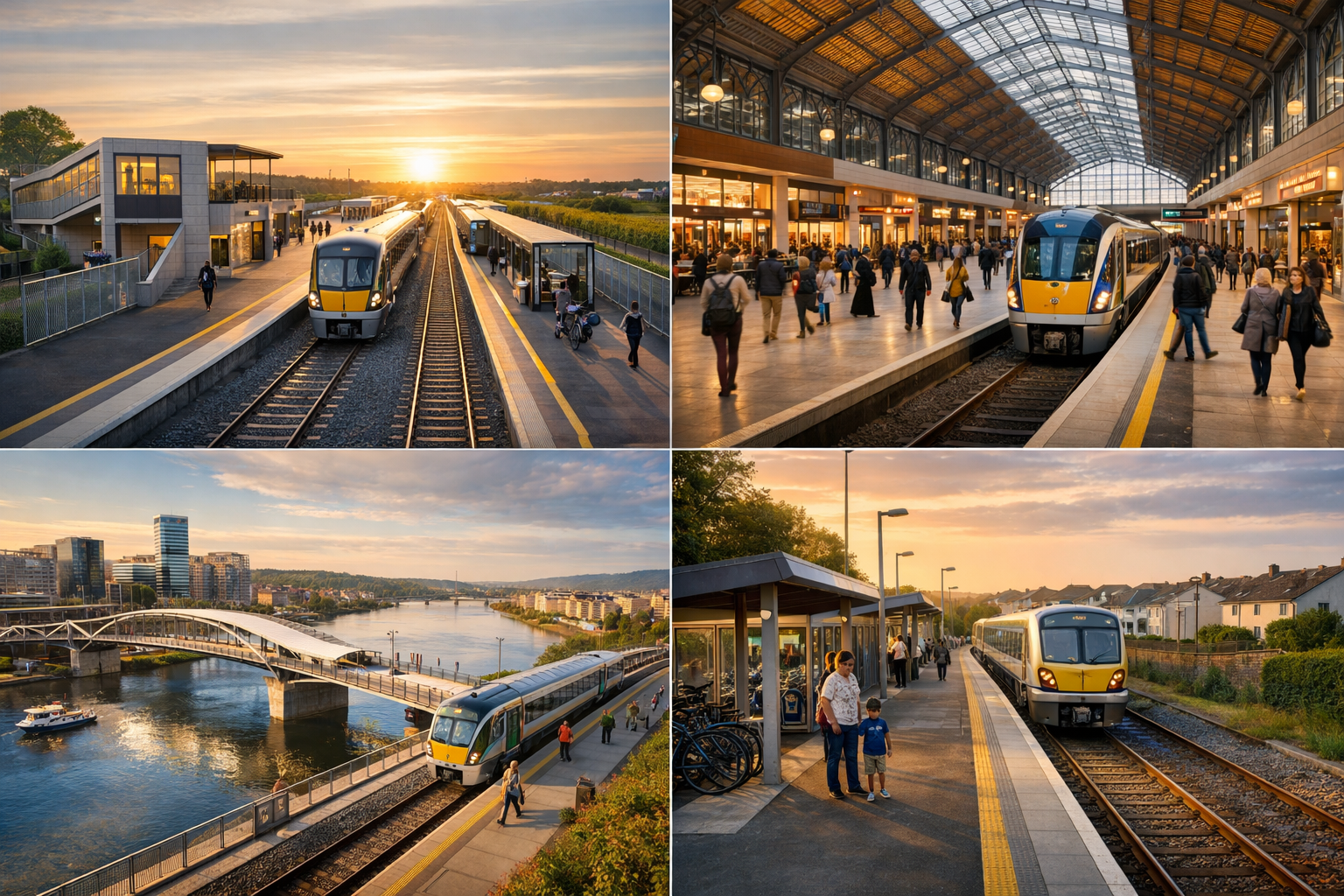
Across Ireland, Iarnród Éireann’s current investment programme points to a railway being reshaped in practical, place-specific ways rather than through any single headline scheme. Supported by the National Transport Authority and linked to Project Ireland 2040, the wider programme spans trains, track, signalling, stations and customer facilities. It sits within the National Development Plan and is presented as part of a broader response to growing transport demand, climate targets and the need for better public transport links between communities.
At network level, the ambition is considerable. Iarnród Éireann says investment will include up to 790 new train carriages, with up to 600 of those planned to be electric or battery electric. Alongside fleet renewal, there is continued spending on track, signalling and level crossings to increase frequency and improve journey times, as well as on new stations and upgrades to existing ones, with accessibility and car parking among the stated priorities. Further investment is also planned beyond the schemes already in progress.
What becomes clear when looking across the current portfolio is that these projects vary widely in scale and purpose. Some are focused on unlocking extra train movements on existing lines, others on creating entirely new transport hubs, while some are designed to resolve long-standing operational constraints. Together, they show a rail system being adapted for a different kind of use, with more frequent suburban services in growing urban areas, better interchange between modes and infrastructure that is more resilient and more accessible than it was previously.
Galway: Two Projects, One Direction
Oranmore Station
In Galway, two separate, but related strands of work illustrate that approach. At Oranmore Station, Iarnród Éireann has planning permission from Galway County Council and Galway City Council for works intended to allow more trains to operate between Galway and Athenry. The present constraint is straightforward: the Athenry to Galway line is currently single track, with no opportunity for trains travelling in opposite directions to pass each other. The planned intervention is equally direct, comprising a one kilometre section of double track at Oranmore Station and a new second platform measuring 185 metres.
That may sound like a modest change in engineering terms, but its operational effect is significant. Iarnród Éireann says the work will allow a doubling of train services calling at the station, bringing service levels to every 30 minutes in each direction. The project is part funded by the Department of Housing, Local Government and Heritage through the Urban Development and Regeneration Fund and part funded by the National Transport Authority, linking local rail improvements to wider housing and planning policy.
The station itself is also set to change in a more visible way. The new platform will sit to the north of the current one and will be reached through a new underpass beneath the railway. That underpass is intended not only for station access but also to provide a dedicated cycle route to lands north of the line. Stairs, a lift and an access ramp are included so that both platforms are accessible, while shelters, help points, customer information signs, lighting, CCTV and seating are all part of the scheme.
The reasoning behind the project extends well beyond the timetable. Iarnród Éireann says the improved station will support the proposed 1,000-unit residential development identified in the Garraun Urban Framework Plan, making it possible for that growth to be compact and sustainable, with public transport readily accessible. The scheme is also described as creating the opportunity for a transport hub serving both the station and the wider Garraun development. In policy terms, it is presented as aligning with the Climate Action Plan, NIFTI, the National Development Plan, the Galway County Development Plan and the Galway Metropolitan Area Strategic Plan, while the hoped-for shift towards rail is expected to reduce noise, emissions and local air pollution.
Progress at Oranmore has moved beyond planning. Advance enabling works began in 2024 and included trackside signalling activity as well as the relocation and modification of telecoms and signalling cables, all intended to prepare for the underpass installation and later main works. The first major construction phase was completed in October 2025, when contractor P&D Lydon installed the new pedestrian and cycle underpass during a planned rail possession weekend on the 11th and 12th of October. The next stage will deliver the remaining elements, including the new platform, the 1 km passing loop, the lift, ramp and stairs and a bridge deck replacement. That contract was tendered in late 2025, with works planned to start in the first half of 2026 and the overall project due for completion by the end of 2027.
Ceannt Station Redevelopment
Galway’s other major rail investment is far larger in urban terms. The redevelopment of Ceannt Station began at the start of 2024 and is funded by the Department of Housing’s Urban Regeneration and Development Fund together with the National Transport Authority. The project is framed around Ceannt’s central location, with Iarnród Éireann describing it as perhaps the best-located railway and bus station among Ireland’s major cities. The aim is to turn it into an expanded and integrated transport hub at the heart of Galway.
Here, the emphasis is on interchange, urban access and future capacity. The redeveloped station is intended to support modal shift towards public and active travel, lower emissions and improved city retail facilities, while also integrating improved rail and bus infrastructure with compact land use development, particularly the proposed Augustine Hill development south of the station. Accessibility is a recurring theme, with mobility-impaired passengers said to be prioritised through features including a Changing Places facility, and the plans also seek to improve circulation inside the station and reduce pressure on Station Road footpaths.
As a physical project, Ceannt Station’s transformation is substantial. Platform numbers are to increase from two to five, allowing for significantly expanded rail services in the future. A new southern entrance and façade will add customer facilities, retail units and toilets, while the existing train hall is to receive a new roof intended to make circulation and platform areas brighter and more welcoming. Renovation of the northern elevation also forms part of the plan, with track, resignalling, drainage and other infrastructure works needed to support the enlarged station. BAM Ireland is carrying out the work for Iarnród Éireann, with substantial completion expected by mid-2026. Throughout the programme, rail and bus services are due to continue, with temporary walking route changes communicated to customers beforehand.
Waterford: A Station Embedded in Urban Renewal
If Galway shows how rail is being used to shape urban growth and improve interchange, Waterford North Quays demonstrates how a station project can be embedded in a much wider redevelopment area. Waterford City and County Council is progressing the North Quays Strategic Development Zone on the north bank of the River Suir in the city centre. The zone is planned as a mixed-use development supported by transport infrastructure, with a new transport hub and railway station approximately 1 km east of the existing Plunkett Station. This new hub will be linked into the city by a sustainable transport bridge.
For the railway, that means more than simply building a replacement station. The project requires remodelling and upgrading of existing track and signalling, while rock face stabilisation works have already taken place at the existing station. It also aims to deal with existing flooding issues that currently restrict railway operations in Waterford. The scope includes a bridge over the railway at the transport hub with the station ticket hall and concourse built into it, a footbridge at the western end of the new station, two vehicular bridges over the railway and two more over the disused New Ross railway line.
The relocation of Plunkett Station to a new site approximately 1 km to the east involves new railway platforms, access stairs and lifts, storage facilities, offices and toilets, as well as a ticket desk, public toilets, a retail unit and related ancillary facilities. Around the station, there will be realignment and provision of double track, signalling works to support the new layout and the removal or decommissioning of the existing level crossing into the North Quays. Spring 2026 has been identified as the proposed opening date, subject to completion of construction and commissioning of the new track and signalling system.
Limerick: A New Station for Moyross
In Limerick, the focus is on a new local station with a regenerative purpose. Iarnród Éireann plans to build Moyross Station on the existing Limerick to Galway line, in what is described as the civic heart of Moyross. The project is intended to improve public transport links for a growing population and to connect the area not only with Limerick city centre but also with Galway, Cork, Dublin and beyond. It also aims to serve nearby destinations including Thomond Park, the TUS Gaelic Grounds, the Technological University of the Shannon and other educational and civic facilities.
Moyross is notable for the way it is tied into other transport plans. The new station is intended to integrate with Limerick City and County Council’s proposed University Avenue scheme, with BusConnects Limerick and with the proposed Limerick CycleConnects network. It is identified as one of the rail-based measures in the Limerick Shannon Metropolitan Area Transport Strategy 2040 and is also listed as an objective in the Limerick Development Plan 2022 to 2028. In that sense, the station is being advanced not as a stand-alone intervention but as part of a wider reshaping of movement through the city.
The emerging preferred option places the station to the rear of Corpus Christi Primary School and Moyross Community Enterprise Centre, with access adjacent to Corpus Christi Parish Church via Sarsfield Gardens and through Millennium Park. The proposed station would have a single platform on the southern side of the line, approximately 175 metres long and between 3 and 4.5 metres wide. Ticket vending machines, passenger information and public address systems and shelters are included, while the western entrance via Millennium Park would be open to pedestrians and provide a bike shelter area. The eastern entrance off Sarsfield Gardens would be for pedestrians only, and bicycle parking would be provided at both entrances.
The stated benefits are concrete and measurable. Approximate journey times are given as 11 minutes to Limerick Colbert, 15 minutes to Sixmilebridge, 32 minutes to Ennis and less than two hours to Galway. Iarnród Éireann also says that by 2043 almost 7,000 people will live within a 15-minute walk of the proposed station. Planning reached an important milestone in November 2025 when Limerick City and County Council issued a Decision to Grant Planning, and advance works were completed in December 2025. Procurement is expected to begin in spring 2026, funded by the National Transport Authority under the Department of Transport’s Pathfinder Programme.
Cork: The Largest Package of All
Cork, however, is where the broadest and most interconnected package of rail works is now under way. The Cork Area Commuter Rail programme forms a central part of the Cork Metropolitan Area Transport Strategy 2040 and is described by Iarnród Éireann as the largest ever investment in Cork’s rail network. It covers the heavy rail network linking Mallow, Cork, Cobh and Midleton and aims to increase capacity and frequency while adding new stations and, in time, electrification.
The programme is being delivered in phases. Phase 1 includes the Kent Station through platform, twin tracking between Glounthaune and Midleton and a signalling and communications upgrade. Phase 2 turns to expansion, with proposals for eight new stations, upgrades to three existing stations, a new depot and full electrification of the Cork rail network. The longer-term goal is an electrified high-frequency rail system with services targeted every 10 minutes.
Phase 1
Phase 1 is the further advanced of the two, with construction already complete on one of its three elements. Each element addresses a distinct part of the same operational problem: removing the bottleneck at Kent Station, adding capacity on the Midleton line and upgrading the signalling infrastructure that underpins both.
Kent Station Through Platform
At Kent Station, new platforms 5b and 6 were designed to remove an operational bottleneck that had long constrained through running. Before the works, most services from Mallow, Midleton and Cobh terminated at Kent, requiring passengers to change if continuing their journey. The new through platforms allow commuter trains to run from Mallow through Kent and onward to Midleton or Cobh without terminating. Construction was completed in March 2025 and the platforms entered service in April 2025, with the official opening attended by Taoiseach Micheál Martin. Works included a 220-metre-long, 6 metre wide double-sided extension to Platform 5, track reconfiguration, retaining wall works and reinstatement of eastern access to the station subway from Platform 5.
Glounthaune to Midleton Twin Track
Further east, the Glounthaune to Midleton Twin Track project covers approximately 10 km from Cobh Junction to Midleton. Its main purpose is the installation of a second track along the full length of the line, together with sidings and turnaround facilities at Midleton, bridge and level crossing modifications, signalling alterations and associated civil works. The project is intended to support an increase from the current 30-minute service to as frequent as every 10 minutes in future, alongside the new through platform, signalling works and a new fleet. A Railway Order was granted by An Coimisiún Pleanála in November 2023, BAM Civil Ltd won the civil works contract worth €29.5 million and construction began in autumn 2024. Completion is expected in late 2026.
Signalling and Communications Upgrade
The signalling and communications upgrade is the less visible but equally necessary part of the same package. It involves new cabling and containment between Mallow and Cobh or Midleton, new signal poles and trackside signalling equipment, power supply points and equipment buildings. It also includes upgrading the Train Protection System in the Cork area to ETCS Level 1 to meet European railway standards. Alstom was awarded the design and build contract in June 2023 and construction started in January 2024, with the works scheduled to finish by the third quarter of 2026. Iarnród Éireann says these upgrades will make possible the future increase to 10-minute frequencies while improving reliability and allowing eventual central management through the new National Train Control Centre at Heuston Station when that becomes operational.
Phase 2: New Stations, New Depot
While Phase 1 continues through to completion, Phase 2 is still being shaped through public consultation. The scale of this second phase is particularly striking, with proposals for eight new stations: Blarney/Stoneview, Monard, Blackpool/Kilbarry, Tivoli, Dunkettle, Ballynoe, Carrigtwohill West and Water-Rock. Mallow, Midleton and Cobh are to be upgraded for accessibility and future capacity. Strategic Park and Ride sites are proposed at Blarney/Stoneview and Dunkettle, each expected to provide between 400 and 600 spaces, while local Park and Ride sites would provide up to 100 spaces. A new depot is also planned at Ballyrichard More, east of Carrigtwohill, to support maintenance and stabling of the future fleet.
The first of two non-statutory consultations on the Emerging Preferred Option took place from the 18th of June to the 23rd of July 2025. Feedback from that process is intended to inform further design development before a second consultation on the Preferred Option. Only after that will a Railway Order application be prepared, followed by the statutory consultation period run by An Coimisiún Pleanála.
The Level Crossings Project
Also on the Cork to Dublin main line, a significant planning milestone was passed in July 2024 for a related scheme. The Cork Line Level Crossings Project is concerned with seven manned public road level crossings between Limerick Junction and Mallow, all within a 24 km section spanning Counties Cork and Limerick. The crossings are at Fantstown, Thomastown, Ballyhay, Newtown, Ballycoskery, Shinanagh and Buttevant. Iarnród Éireann says the objective is to identify the best approach to removing or upgrading them in order to improve safety for nearby residents and support a more efficient rail service. A Railway Order was lodged with An Coimisiún Pleanála, an oral hearing took place in September 2022 and approval was granted in July 2024 after a process lasting over 37 months.
The Broader Picture of Rail Investment in Ireland
Taken together, these schemes show how rail investment in Ireland is being pursued through many linked interventions rather than one simple expansion. Some projects address capacity on single-line sections, others rebuild city stations as transport hubs and others still modernise the systems that sit behind daily operations. What unites them is a recurring set of themes: higher frequencies, better interchange, improved accessibility, support for housing and urban development and a stated move towards lower-emission travel. The exact pace of delivery will continue to depend on procurement, planning and construction, but the direction of travel is already clear.
Recent Musings
October 2026 Wirral Bus Network Changes Under Liverpool City Region Franchising
West Cork Bus Connections for Walkers and Other Visitors
Planning County Kerry Walks and Day Trips by Bus
Discovering County Mayo Using Public Transport
Appraising Bus Routes for a Car-Free Walking Trip in Donegal
Extras & Utilities
Carrying Bicycles on Buses in Britain and Ireland
Not Just Blogs, A Collection of Public Transport News Sources