Integrated Rural Transport Coming to Derbyshire
 Posted on April 10, 2026
 Reading time: 2
minutes.
Reading time: 2
minutes.
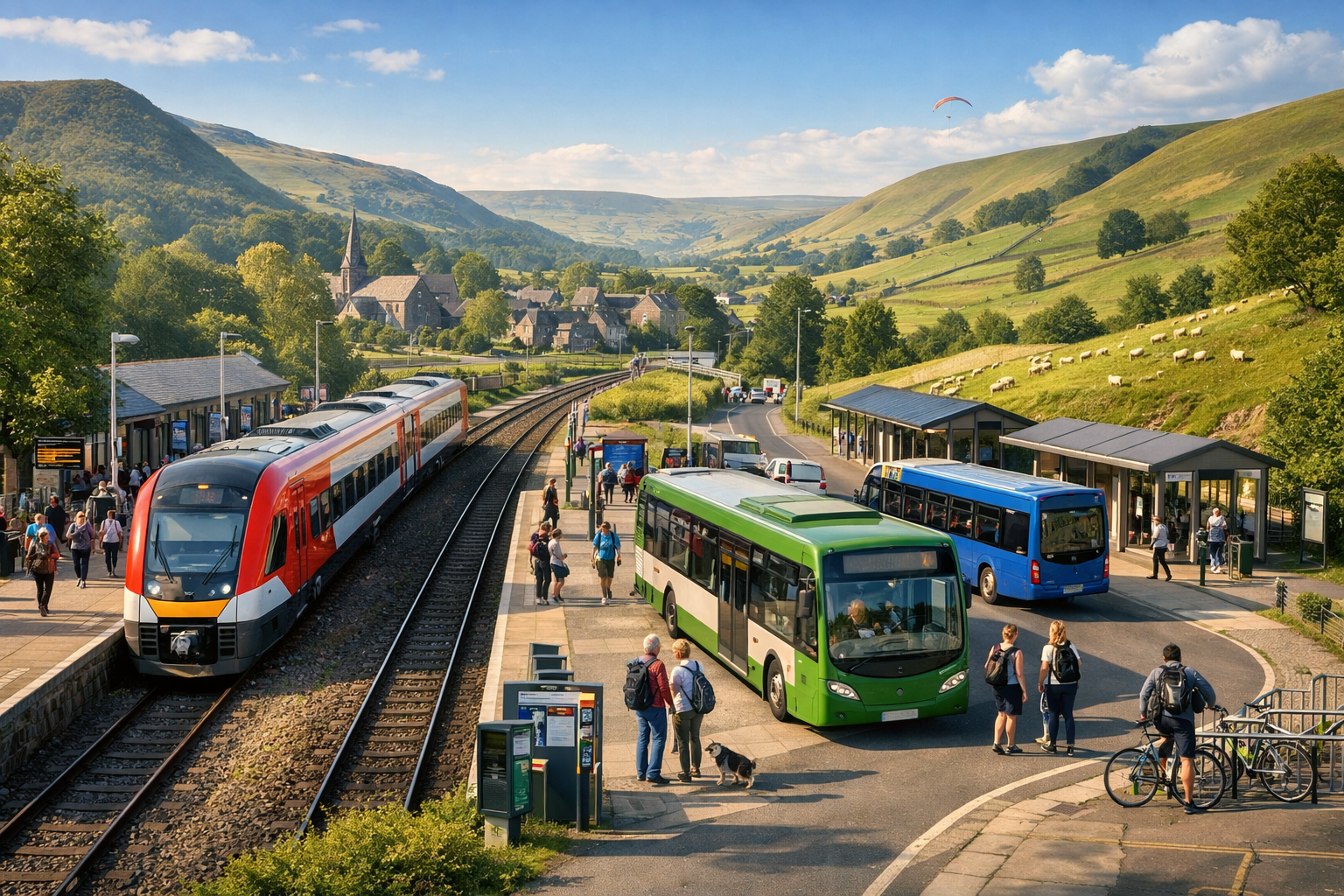
Inspired by Switzerland’s world-renowned rural public transport system, Mini Switzerland is a national demonstrator project aimed at transforming how people travel in rural Britain, using Derbyshire’s Hope Valley as its real-world testing ground. The project, developed by Hope Valley Climate Action with funding from the Foundation for Integrated Transport, proposes building a fully integrated network of buses and trains operating to a regular clock-face timetable, with services running at the same times each hour, every hour, from early morning until late at night, seven days a week. Buses would connect seamlessly with trains at key interchange hubs at Bamford, Hope and Edale stations, ticketing would be simplified into a single unified product valid across all operators and modes, and every village along the corridor would be served at least hourly.
The Hope Valley is considered an ideal location because it already has an hourly rail service linking Sheffield and Manchester, a mix of villages, schools, workplaces and visitor attractions, and millions of annual visitors to the Peak District National Park, nearly all of whom currently arrive by car. Around one in three households in both Sheffield and Manchester has no access to a car, meaning large parts of the National Park are effectively unreachable for a significant proportion of the urban population.
The project requires modest capital investment of around one million pounds in infrastructure improvements such as hub upgrades, bus stop enhancements and signage, alongside estimated annual operating costs of around four million pounds in its first full year, falling as ridership grows. Crucially, the demonstrator is designed to generate structured, measurable evidence on passenger behaviour, operational reliability, ticketing uptake and demand growth over a five-year period, providing a practical model that rural authorities, National Parks and combined authorities across Britain can study, adapt and replicate.
Recent Musings
West Cork Bus Connections for Walkers and Other Visitors
Planning County Kerry Walks and Day Trips by Bus
Discovering County Mayo Using Public Transport
Appraising Bus Routes for a Car-Free Walking Trip in Donegal
Exploring Mid Wales by Public Transport from Shrewsbury, Newtown and Llandrindod Wells
Extras & Utilities
Carrying Bicycles on Buses in Britain and Ireland
Not Just Blogs, A Collection of Public Transport News Sources