The Government Company Quietly Nationalising Britain's Passenger Train Operating Companies
 Posted on February 6, 2026
 Reading time: 12
minutes.
Reading time: 12
minutes.
Britain’s passenger railway has been moving through a prolonged period of structural change, with the old franchising model replaced by management-style contracts and an increasing share of train services brought into public ownership. In the middle of this sits DfT Operator Ltd, a government-owned company that has shifted from being an emergency backstop to becoming the main holding structure for nationalised passenger operators in England. While many passengers will notice little beyond the familiar brand names on trains and stations, the corporate and governance arrangements behind those brands have been changing at pace.
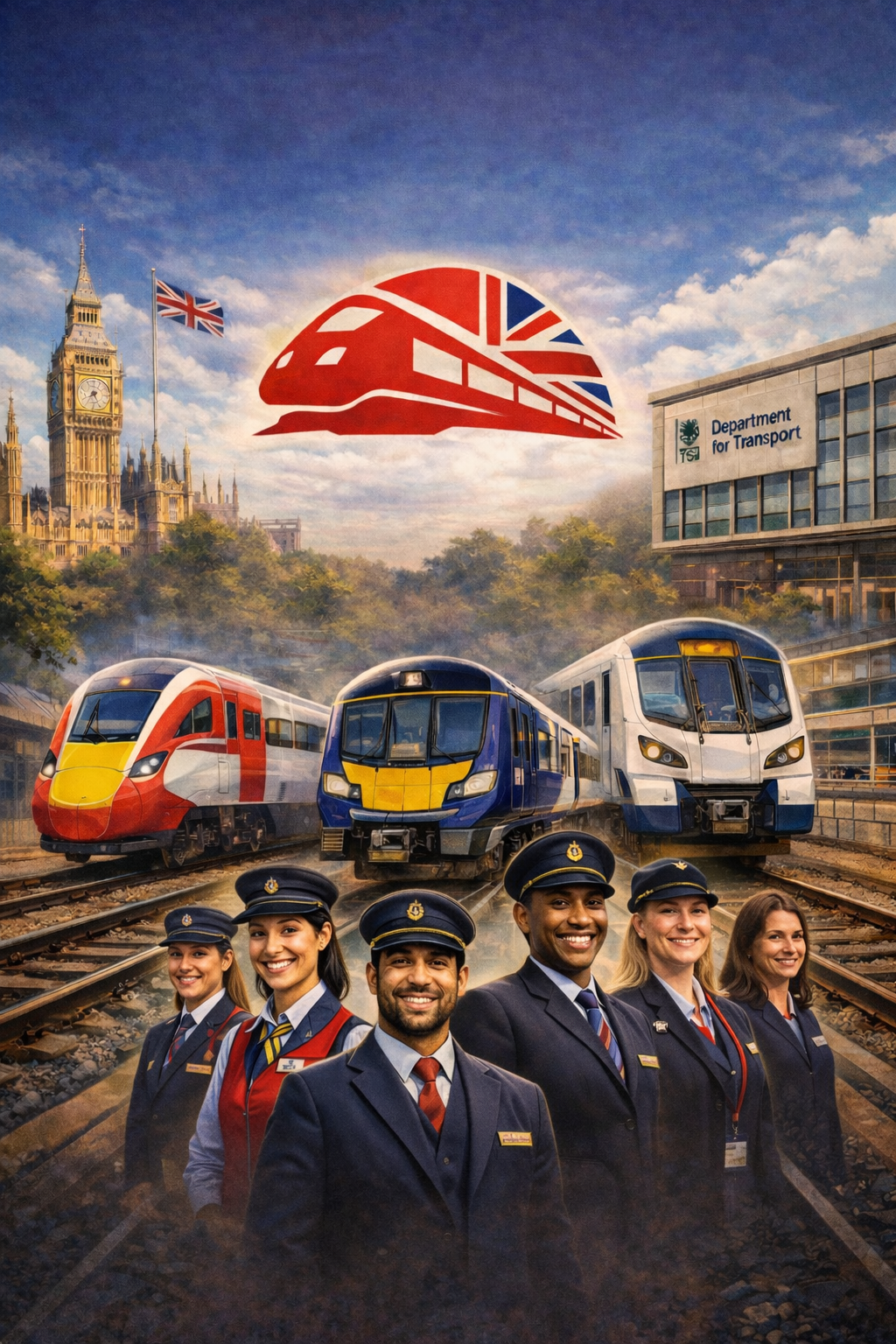
DfT Operator Ltd is wholly owned by the UK government through the Secretary of State for Transport. Its role is to own and oversee passenger train operating companies that have been brought into public ownership, ensuring services continue to run and that there is a clear management structure for operators that are no longer privately run. What began as a contingency arrangement has become a central pillar of rail reform, and DfT Operator Ltd’s purpose has expanded into something more like a temporary national operating group for England, ahead of the planned creation of Great British Railways.
Origins and Legal Framework
The company began life in 2018 under the name DfT OLR Holdings Limited, created primarily to support the government’s “operator of last resort” function. The phrase “operator of last resort” explains the original logic. If a private franchise collapsed, was terminated or could not continue, the government needed a mechanism to take over quickly so that timetables, staffing and safety-critical operations could continue without interruption. From a passenger perspective, this kind of transfer is designed to be as quiet as possible. Trains still run, tickets remain valid and the public-facing brand often stays the same. Behind the scenes, however, the legal company running those trains changes ownership, with DfT Operator Ltd becoming the parent body responsible for governance and oversight.
In 2024 the company was renamed DfT Operator Limited, reflecting a broader shift in policy where public ownership is no longer presented only as a fallback when an operator fails, but as an increasingly standard destination as contracts end and the railway is reorganised. Over time, the franchising system has ended and the newer National Rail Contracts have tended to place more revenue and risk with government, making the step into direct ownership less of a leap than it once appeared. As a result, DfT Operator Ltd’s portfolio has grown considerably.
Part of understanding this landscape is recognising the difference between the brand passengers see and the legal entity behind it. Brands like LNER or Northern are what appear on trains, websites and station signs, but the companies that hold licences, employ staff and sign contracts are legally constituted firms such as London North Eastern Railway Limited and Northern Trains Limited. DfT Operator Ltd sits above these operating companies through a corporate structure that includes intermediate holding and management subsidiaries used for governance, financial structuring and liability separation.
Among the companies in this layer are Train Operating Company Holdings Limited, DfT Operator Railways Limited and DfT Operator Management Limited. There are also intermediate parents linked to particular operators, including London North Eastern Railway Holdings Limited and Northern Trains Holdings Limited. These names rarely appear in public discussion, but they matter for how the system is administered and how accountability is arranged.
The Transfer Programme: Chronology
The most prominent early example of a transfer into public ownership under this structure was London North Eastern Railway, which took over East Coast Main Line services on 24th June 2018. LNER replaced Virgin Trains East Coast after franchise failure, and it has since become one of the best-known government-owned operators, running long-distance trains connecting London with major centres such as York, Newcastle, Edinburgh, Leeds, Aberdeen and Inverness. The LNER transfer set the template for what would follow, demonstrating that services could continue seamlessly under public ownership while the railway’s longer-term future was decided.
The next major transfer followed on 1st March 2020 when Northern Trains entered public ownership, bringing a vast regional network across Northern England under DfT Operator Ltd’s control. This was a significant expansion in scale, taking in a complex web of local services across cities, towns and rural areas from the Humber to Cumbria. Northern’s transfer reinforced the pattern established by LNER: public ownership as a practical response to franchise difficulties rather than an ideological statement.
The pace of change continued into the early 2020s. SE Trains, the legal company behind the Southeastern brand serving London, Kent and parts of East Sussex including Highspeed services from St Pancras, transferred in October 2021. TransPennine Trains, operating TransPennine Express services connecting key cities across Northern England and into Scotland, followed on 28th May 2023. Each transfer reinforced the idea that DfT Operator Ltd was no longer simply an emergency stand-in but the main mechanism for keeping operators running while the industry’s long-term shape was decided.
In December 2025, Alex Hynes was appointed as CEO of DfT Operator Limited, taking over from Robin Gisby who had overseen the company through its earlier expansion. Hynes assumed leadership as the company prepared for its largest transfers yet, including the integration of Govia Thameslink Railway scheduled for May 2026.
The year 2025 marked a decisive acceleration in the transfer programme. In July 2024, the Labour Party won the general election with a manifesto commitment to renationalise the railways, and the Passenger Railway Services (Public Ownership) Act 2024 received Royal Assent in November. This legislation allowed passenger rail services to be returned to state control without requiring the purchase of private contracts, fundamentally changing the context in which DfT Operator Ltd operated. Public ownership was now policy rather than contingency.
Several further transfers were confirmed in quick succession, broadening the footprint of public ownership into some of the busiest commuter territory in the country. South Western Railway transferred on 25th May 2025, taking into public ownership an operator that runs from London Waterloo across a large part of the south west of England, linking destinations such as Southampton, Bournemouth, Portsmouth and Exeter and serving one of the most heavily used commuter networks in Europe.
c2c Rail, known for services between London Fenchurch Street and Essex destinations including Southend and Tilbury, transferred on 20th July 2025. Greater Anglia, operating across the East of England and serving places such as Norwich, Cambridge, Stansted Airport and Ipswich, transferred on 12th October 2025, bringing with it a network that had been recently modernised with a new train fleet.
The sequence continued into 2026. West Midlands Trains transferred on 1st February 2026, bringing the West Midlands Railway and London Northwestern Railway brands into public ownership. These services link London Euston with Birmingham, Liverpool and Crewe and also provide extensive regional coverage around Birmingham. Taken together with earlier transfers, this meant that by February 2026, eight of the fourteen English operators were already owned by DfT Operator Ltd, a significant change from a system that for years was framed around private operation under franchise agreements.
Alongside the list of operators already in public ownership, the government has also set out a programme for bringing remaining operators across. A particularly significant forthcoming transfer is Govia Thameslink Railway, confirmed to move on 31st May 2026. GTR is the largest operator in Britain and runs Thameslink, Southern, Great Northern and Gatwick Express, meaning it covers a large portion of London and the South East commuter railway and includes major airport links. The scale and complexity of this network means its transfer is a milestone in the nationalisation programme, not just another incremental addition.
Beyond GTR, further transfers have been confirmed as part of the programme even if final dates were not set out in the same way. Chiltern Railways, operating services from London Marylebone towards Birmingham and across parts of Buckinghamshire and Oxfordshire, has been identified in the next phase. Great Western Railway, which runs major intercity and regional services from London Paddington to Bristol, Cardiff and South Wales as well as routes into Devon and Cornwall, has also been confirmed in the programme. Avanti West Coast, operating intercity services on the West Coast Main Line between London and destinations including Birmingham, Manchester, Liverpool and Glasgow, has been identified as expected to transfer before the completion of the programme. CrossCountry, which provides long-distance links between regional cities without going through London, has also been identified as part of the remaining set expected to transfer by the end of the programme.
The overall stated direction is that transfers occur as contracts expire and that the process is expected to complete by October 2027.
How DfT Operator Ltd Works
From a passenger perspective, the transfer of an operator into DfT Operator Ltd is designed to be as seamless as possible. Trains continue to run on the same timetables, tickets remain valid, station facilities stay open and staff uniforms typically remain unchanged, at least initially. The public-facing brand is often retained, meaning that passengers boarding a Northern or LNER train see the same branding they would have seen under private operation. This continuity is deliberate. The Department for Transport is keen to avoid the kind of disruption that can accompany major organisational change, and the operational priority is to maintain service levels while ownership structures shift.
Behind the scenes, however, significant changes occur. The legal entity that holds the operating licence, employs staff and contracts for services changes hands. Management reporting lines shift, with operators now accountable to DfT Operator Ltd and through it to the Department for Transport rather than to private shareholders. Financial structures change too, with revenue and cost risk increasingly sitting with government rather than private operators. This reflects the broader trend under National Rail Contracts even before transfer, where the franchising model’s commercial risk has already been substantially removed.
DfT Operator Ltd functions as a holding company rather than an operational railway manager. It owns the train operating companies, provides governance and oversight, and ensures that performance standards are met. Day-to-day management of train services, staff and customer-facing operations remains with the individual operators, which retain their own management teams, depots, control centres and operational structures. The model is one of oversight and strategic direction rather than direct management from the centre.
The Limits of DfT Operator Ltd
DfT Operator Ltd’s remit is confined to England and to operators contracted with the Department for Transport. This means there are significant parts of Britain’s railway that sit outside its scope and will continue to do so.
Devolution means that Scotland and Wales have their own public ownership arrangements. ScotRail, Caledonian Sleeper and Transport for Wales Rail are already publicly owned, but not by DfT Operator Ltd and not by the Department for Transport. ScotRail is owned by the Scottish Government through Scottish Rail Holdings, with ScotRail Trains Ltd in public ownership since 1st April 2022. Caledonian Sleeper is also owned by the Scottish Government through Scottish Rail Holdings, transferring into public ownership in June 2023, and although its services run to London, it is treated as a devolved Scottish operation. Transport for Wales Rail Ltd is owned by the Welsh Government through Transport for Wales and has been in public ownership since February 2021. These operators are not expected to be absorbed into DfT Operator Ltd and they will remain under the control of their respective devolved governments.
An important nuance in the current official sequence is that East Midlands Railway, which runs from London St Pancras to cities including Nottingham, Derby and Sheffield, was not included in the confirmed transfer sequence described in the same terms as GTR, Chiltern, GWR, Avanti and CrossCountry. That absence does not necessarily indicate a permanent exception, but it does mean that the operator has not been formally scheduled in the way others have been in the programme described above. The reasons for this remain unclear, and it is possible that East Midlands Railway could be added to the programme at a later stage.
Not every operator on Britain’s railway fits into the passenger public ownership programme, and this is where open access and freight provide important context. Open access passenger operators such as Lumo, Hull Trains and Grand Central operate outside the contracted system entirely. They are private companies that run services on the national network without government contracts and without operating subsidy, taking commercial risk and relying on ticket revenue. Lumo, owned by FirstGroup, began running low-cost services between London King’s Cross and Edinburgh in 2021. Hull Trains, also owned by FirstGroup, has operated between London King’s Cross and Hull since 2000. Grand Central, owned by Arriva Group, has run services since 2007, linking London with Sunderland and Bradford. These operators pay track access charges and fit into the timetable through an approvals process, but they are not part of DfT Operator Ltd and are not scheduled for nationalisation.
Freight sits even more clearly outside the passenger ownership debate. Britain’s rail freight sector has been fully privatised since the 1990s and is expected to remain so. Freight operators also pay access charges to use the network and continue to run commercially. The main companies include DB Cargo UK, owned by Deutsche Bahn, Freightliner owned by Brookfield Asset Management, GB Railfreight owned by Infracapital and Colas Rail UK owned by the Colas Group. Direct Rail Services is a notable exception in ownership terms, being owned by the UK Nuclear Decommissioning Authority, but it remains separate from DfT Operator Ltd and operates specialist traffic including nuclear material as well as other freight and support services.
DfT Operator Ltd as Transition
DfT Operator Ltd is best understood as a transitional structure. It exists to hold and manage operators in public ownership before Great British Railways is fully created and able to absorb them into a single national framework. On the basis of the programme described above, most operators are expected to have transferred into DfT Operator Ltd by the end of 2027, with DfT Operator Ltd itself likely to be absorbed into GBR during the 2027 to 2028 period, depending on the timing of legislation and implementation.
This transitional status shapes how DfT Operator Ltd operates and how it is perceived. It is not presented as a permanent feature of the railway landscape but as a temporary holding structure that will eventually be superseded. This explains why branding remains operator-specific rather than unified under a DfT Operator Ltd identity, and why operational structures remain largely unchanged from the franchise era. The expectation is that more fundamental restructuring will occur once Great British Railways is established and able to take a comprehensive view of the passenger railway as a whole.
Viewed as a whole, DfT Operator Ltd has become the organising centre of England’s passenger rail nationalisation programme, holding a growing set of operating companies while the sector moves towards a Great British Railways model. At the same time, devolved public operators in Scotland and Wales remain outside that structure, and privately run open access and freight operators remain permanent features of the network. The result is a railway that may look broadly familiar to passengers day-to-day, yet is being reshaped behind the scenes through ownership transfers, new governance bodies and a reworked balance between public control and regulated access for commercial operators.
Recent Musings
October 2026 Wirral Bus Network Changes Under Liverpool City Region Franchising
West Cork Bus Connections for Walkers and Other Visitors
Planning County Kerry Walks and Day Trips by Bus
Discovering County Mayo Using Public Transport
Appraising Bus Routes for a Car-Free Walking Trip in Donegal
Extras & Utilities
Carrying Bicycles on Buses in Britain and Ireland
Not Just Blogs, A Collection of Public Transport News Sources