An Introduction to Canadian Train Travel for Independent Travellers
 Posted on November 26, 2025
 Reading time: 10
minutes.
Reading time: 10
minutes.
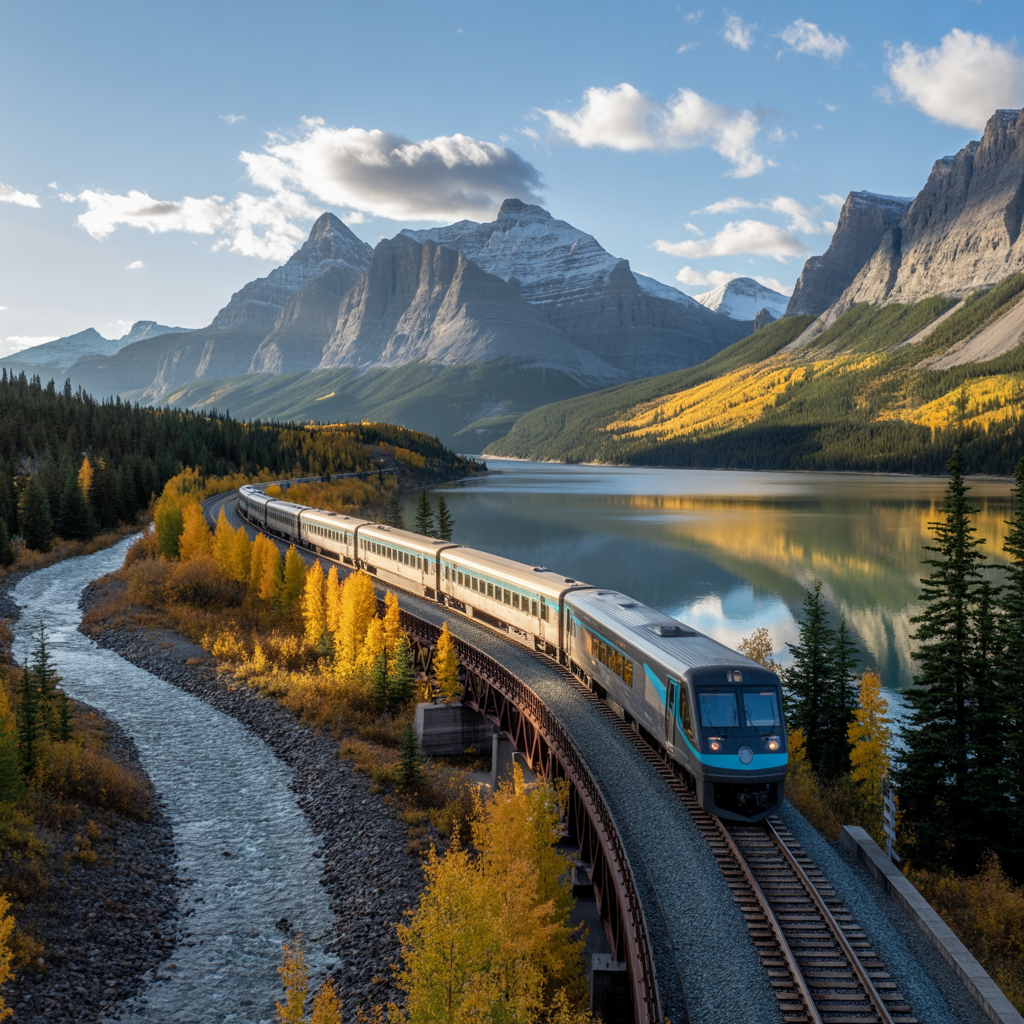
Canada by rail rewards patience with careful planning. The country’s railways are a patchwork of services shaped as much by geography as by history, and understanding what exists, and what it is intended to do, is the key to a journey that makes sense. This guide explains how Canadian rail works, where it excels and where it falls short, so you can decide whether trains belong in your itinerary at all.
The national network: VIA Rail
VIA Rail is Canada’s national passenger operator, though “national” overstates its reach. The network divides into three distinct families of service, each with its own logic and purpose.
The Corridor: practical intercity rail
The Corridor is the spine of VIA Rail’s operations, linking Windsor, Toronto, Ottawa, Montreal and Quebec City. This is the only region where rail often proves the best alternative to flying or driving, especially for trips such as Toronto to Ottawa or Montreal, or Montreal to Quebec City. Trains run frequently on the busiest sections, journey times are competitive when Canadian distances are considered, and reliability is generally reasonable, though freight traffic on shared tracks can introduce delays.
Fares use dynamic pricing, so costs fluctuate with demand and time of booking. There is a clear advantage in securing tickets well in advance rather than leaving things to the day. Think of this as Canada’s answer to European intercity rail: not quite the same frequencies or speeds, but a genuine transport option rather than a tourist experience.
Long-distance trains: the journey as the point
Beyond the Corridor sit VIA Rail’s classic long-distance trains, which are as much about experience as speed. The Canadian links Toronto and Vancouver across northern Ontario, the Prairies and through the Rocky Mountains to the Pacific, a journey of several days. The Ocean connects Montreal with Halifax across maritime landscapes. The Winnipeg to Churchill service strikes north into the sub-Arctic, where the railway provides a lasting link to remote communities.
These trains are scenic rather than swift. Freight traffic takes priority on many of the routes they use, so timetables include generous recovery margins and delays are not uncommon. The result is closer to a railway cruise than a fast intercity dash, with time to watch horizons change from boreal forest to mountain and sea. If you are travelling to reach a destination punctually, these trains will frustrate. If you are travelling to see the country at a pace that allows looking, they open windows the highway sometimes skirts.
Regional services: access over speed
VIA Rail also operates regional routes that function as lifelines for places roads struggle to serve reliably. Trains from Quebec to Saguenay, from Montreal to Senneterre and Jonquiere, and between Sudbury and White River progress steadily through country that can feel far removed from urban Canada. They may run only a few times a week and stops can be little more than a sign by the track, sometimes requested in advance. What they offer is access, connecting remote communities to larger centres with a regularity that cannot be taken for granted in all seasons.
Private sightseeing trains
Alongside the national network sit private operations designed expressly for the journey. The Rocky Mountaineer is the best known, a luxury daylight operation in western Canada linking Vancouver with Banff, Lake Louise and Jasper. The emphasis is entirely on scenery and service on board, with overnight stays in hotels because the trains do not run through the night. The Agawa Canyon Tour Train is a seasonal excursion operating out of Sault Ste Marie into northern Ontario’s forests and lake country.
These trains are not intended to convey travellers from A to B in the most practical manner. They are curated experiences on rails, structured around daylight vistas rather than timetables optimised for transport. They are expensive, but if the journey itself is what you seek, they deliver.
Urban and regional networks
Canada does not have a single integrated regional rail system. Each metropolitan area builds to its own needs, and the mix of services reflects urban form, rail ownership and the long shadow of freight railways whose infrastructure must often be shared.
Toronto
Toronto has the country’s largest suburban rail system, operated under the GO Transit brand and radiating from Union Station to places such as Hamilton, Oshawa, Kitchener and Barrie. The network is built around seven main commuter corridors and is in the midst of a long-term expansion programme that includes electrification and more frequent services on the core routes. Integration with the Toronto Transit Commission’s subway and buses is well established through shared stations and the Presto smart card.
The TTC Subway is the most substantial conventional metro network, with Line 1 forming a long U linking much of central Toronto, Line 2 running east to west across the city and Line 4 providing a short corridor under Sheppard Avenue. Construction of the new Ontario Line aims to add capacity across the core.
Montreal
Montreal’s commuter network, managed by Exo, comprises five lines that reach Saint-Jerome, Mont-Saint-Hilaire, Mascouche and Vaudreuil among other suburbs. Services on some routes are concentrated in peak hours, with limited trains during the middle of the day and in the evening. The network is integrated with the metro and buses via ARTM fare zones and the OPUS card, yet the geometry of the lines reflects their foundation on freight corridors, which means stations can be widely spaced.
The STM Metro uses rubber-tyred trains on four lines that span the city from east to west and north to south. Rubber tyres allow steeper gradients and quiet running, and the system offers dense station spacing in the centre with reliable frequencies. The new REM automated system is gradually reshaping travel patterns across the region, but the classic heavy rail commuter lines remain important.
Vancouver
Vancouver’s conventional suburban rail presence is the West Coast Express between Waterfront Station and Mission. It is best understood as a peak-hour operation with inbound trains in the morning and outbound trains in the evening, and there is no midday or weekend service. It connects seamlessly with TransLink’s SkyTrain, SeaBus and extensive bus network.
SkyTrain is a driverless automated light metro rather than a traditional underground. Its three main lines run mostly above ground on viaducts with very short headways, providing fast journeys across Vancouver, Burnaby, New Westminster, Surrey and Richmond. Grade separation underpins reliability and the elevated alignments offer views that feel distinct from a conventional metro.
Other cities
Calgary and Edmonton have no commuter rail as such. Calgary’s CTrain and Edmonton’s LRT fulfil the principal rail role in each city and are designed as urban light rail rather than regional heavy rail, even if some corridors extend over notable distances. Ottawa’s O-Train bridges categories, with Line 1 functioning as a metro through the centre and Line 2 operating as a surface diesel service with more of a regional character. Quebec City has no suburban railway, and attention has turned to tramway proposals that have been revised several times.
Light rail: a spectrum of solutions
Light rail has taken on a range of roles in Canada. Calgary’s CTrain is among North America’s busiest light rail networks, built around two primary lines with much of the route mileage at surface level on dedicated alignments. High frequencies in the core and long articulated vehicles carry heavy loads. Edmonton blends older high-floor technology with newer low-floor LRT and has been expanding gradually into suburban areas. Ottawa’s Line 1 uses low-floor trams with a central tunnel and full segregation in the core, making it feel metro-like across its busiest stretch. Kitchener-Waterloo’s Ion mixes reserved track and street running and is tightly integrated with local buses.
These different models tend to fall into two broad patterns. In one group sit the high-capacity commuter-focused lines that run mostly on segregated alignments and behave like metro systems over long distances. In the other are those that blend street running with reserved sections and therefore have more of a tramway temperament. The balance between speed, segregation and street presence is chosen to match urban form and demand.
Practical realities
The practical realities of rail travel in Canada reflect the scale of the country and the role of freight. Journeys take longer than many European travellers might expect and the potential for delay exists wherever cargo has priority. Comfort is usually high, particularly on long-distance services with sleeping and dining arrangements or on premium tourist operations. Stations range from major urban hubs to very small request stops, and it pays to check what awaits at either end of a journey.
In terms of cost, the Corridor behaves like an airline market with dynamic pricing, and booking ahead brings the price down more often than not. Outside that core, fixed patterns prevail and flexibility tends to be limited because frequencies can be sparse.
When trains make sense
Trains are at their most practical for travel within the Corridor cities where frequencies and speeds are strong relative to the alternatives, for scenic long journeys where the experience outweighs the extra hours on the clock, and for reaching remote regions that lack reliable roads. They are less suitable when time is tight and the distance long, when a rural destination sits far from a railhead, or when plans demand last-minute changes that a timetable with only a few trains a week cannot easily absorb.
Suggested routes capture these strengths. Toronto to Ottawa or Montreal is a straightforward intercity trip. Montreal to Quebec City is both scenic and convenient. The Canadian offers a multi-day coast-to-coast traversal that has become a journey to savour in its own right. The Ocean opens the Atlantic provinces to rail travellers. The segment from Jasper to Vancouver, whether aboard VIA Rail or the Rocky Mountaineer, gives memorable mountain landscapes even to those with only a few days to spare.
Integration and ticketing
Integration with local transport is strong in the larger centres. Toronto’s GO Transit knits into the TTC with stations that make transfers straightforward and the Presto smart card used across modes. Montreal’s Exo sits within ARTM fare zones and uses the OPUS card alongside the metro and buses. Vancouver’s West Coast Express dovetails with TransLink’s network and taps the same fare media. Elsewhere, networks are designed to hand over to buses where rail does not go, and the rail lines that exist often form the spine of a wider multi-modal plan.
On the intercity side, fares in the Corridor rise and fall with demand and booking in advance typically secures better value. On the long-distance routes, build cushions into plans because the mix of freight priority and vast geography can undermine tight connections. Stations may be grand or minimal, and it is worth checking what facilities will be available at departure and arrival, especially on regional services where request stops remain a feature.
Setting expectations
Canada’s railways present a spectrum from rapid urban movement to slow, contemplative crossings of whole provinces. In the Corridor they offer practical links that can replace short-haul flights with ease. Across the Rockies or into the sub-Arctic they open windows on landscapes that the highway sometimes skirts, and in cities they provide the fixed frameworks into which buses and active travel fit.
The result is not a single network but a set of interlocking parts. Treat them on their own terms, and they can take you a long way, whether the aim is to cover ground with purpose or to watch the country roll by at a pace that leaves time for looking. Do not expect European frequencies or Japanese punctuality. Do expect comfort, scenery and a mode of travel that still matters in a country built by railways, even if much of what once existed has been lost.
Recent Musings
West Cork Bus Connections for Walkers and Other Visitors
Planning County Kerry Walks and Day Trips by Bus
Discovering County Mayo Using Public Transport
Appraising Bus Routes for a Car-Free Walking Trip in Donegal
Exploring Mid Wales by Public Transport from Shrewsbury, Newtown and Llandrindod Wells
Extras & Utilities
Carrying Bicycles on Buses in Britain and Ireland
Not Just Blogs, A Collection of Public Transport News Sources