Why German Trains Cannot Simply Copy Swiss Precision or French Speed
 Posted on November 9, 2025
 Reading time: 6
minutes.
Reading time: 6
minutes.
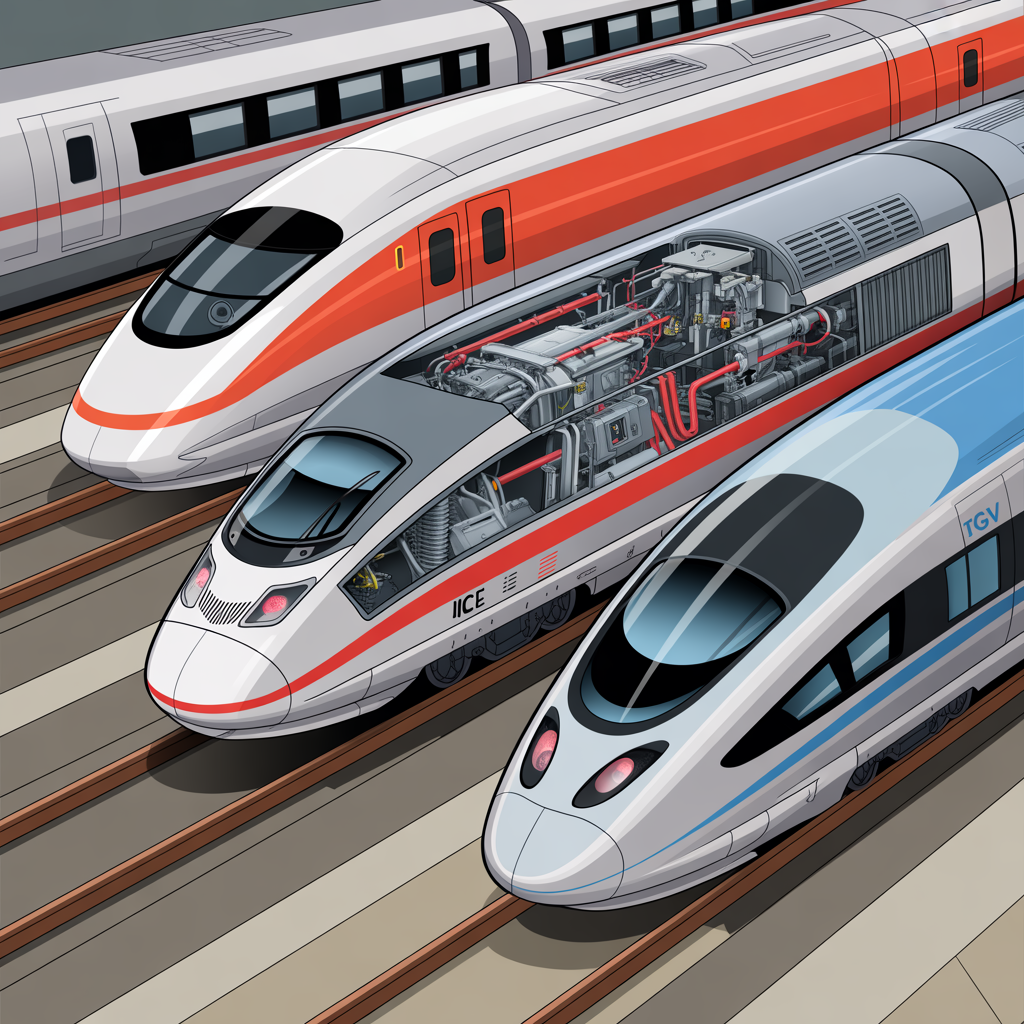
Germany’s choice to prioritise reach over pure speed sits within a broader European landscape of railway models, each shaped by different priorities and constraints. Comparing how neighbouring countries organise and fund their networks helps explain why punctuality, speed and passenger satisfaction vary so widely across the continent, and why solutions that work in one setting do not always translate to another.
Dedicated speed versus mixed traffic
France built a TGV system that separates most high-speed travel from conventional traffic, achieving punctuality around 90% and average speeds of 200 to 230 km/h between major cities. The network remains strongly centred on Paris and cross-country trips can be awkward, but the dedicated lines deliver consistency. Germany wove high-speed sections into existing corridors, allowing ICE trains to share track with regional services and freight. The result is broader coverage but lower reliability, with long-distance punctuality at 62.5% in 2024 compared to regional trains at 90%. The structural difference is stark. France sacrificed some connectivity for speed and precision, Germany chose the opposite and lives with the trade-offs.
Precision through discipline
Switzerland manages an intensely used network with remarkable precision, rarely exceeding 200 km/h yet achieving punctuality around 93% through robust timetabling, reliable connections and continuous small improvements rather than spectacular new lines. The model depends on meticulous planning, generous buffers and a culture of incremental refinement. Trains coordinate across operators and modes, connections are protected and delays are contained before they cascade. The Swiss approach works because the network is smaller, the topography forces discipline and investment has been sustained over decades. Germany’s scale and mixed-traffic complexity make direct replication impossible, yet the principle of building slack into timetables and prioritising reliability over maximum frequency resonates.
Austria keeps infrastructure and operations within a public group, allows open-access competitors on key corridors and maintains punctuality close to 90% with steady investment. The structure resembles Germany’s, but the network is smaller and less congested, allowing tighter control. The Netherlands runs a state infrastructure manager with a dominant national operator, achieving punctuality above 90% despite limited top speeds and very high usage per kilometre of line. Intensive use is managed through careful coordination and a willingness to invest in capacity at pinch points. Both countries show that public ownership does not guarantee outcomes, execution matters more than structure.
Transitions and compromises
The United Kingdom is creating Great British Railways to bring planning, fares and timetabling back under public control, with long-distance punctuality commonly between 85 and 90%, top speeds of 200 km/h on upgraded lines and true high-speed services waiting on the delayed HS2 project. The shift reverses decades of fragmentation and acknowledges that splitting infrastructure from operations created coordination failures.
Norway and Sweden use public infrastructure agencies and a mix of public service contracts and open access for operators, targeting reliability and cost control with long-distance punctuality typically in the high eighties. The Scandinavian model balances public accountability with competition, though sparse populations and long distances limit direct comparison with denser networks further south.
Spending and outcomes
Spending patterns correlate with outcomes. Recent data from 2024 shows Austria has invested about €352 per person and Switzerland about €480 per person on rail infrastructure, while Germany’s per-capita figure reached €198 in 2024, a significant increase from around €115 in previous years but still trailing its Alpine neighbours.
Switzerland has committed substantial funds for ongoing maintenance and expansion through programmes like the 2035 Rail Expansion Step, while Austria maintains a multi-billion euro infrastructure plan. Germany’s totals are enormous in absolute terms, yet when spread across a vast and ageing network they do not immediately translate into the reliability seen in smaller systems.
Usage intensity plays a part as well. The Netherlands and Switzerland record very high passenger train-kilometres per route-kilometre each day and still perform well, but Germany’s mixed traffic shows its strain in freight figures alone, with around 19 freight train-kilometres per route-kilometre per day in 2022 on parts of the network. Add tens of thousands of daily passenger trains and the room for recovery reduces when something goes wrong.
Structural differences in practice
Comparisons between similar-length journeys underline the structural differences. London to Edinburgh is roughly 640 km by rail and can be as quick as four hours ten minutes on the East Coast Main Line using 200 km/h trains, with high reliability by European standards. Munich to Hamburg is longer at about 800 km and comes in close to six hours despite a higher top speed, because the line weaves through mixed-traffic sections and slows for approaches and junctions. Rail remains city-centre to city-centre in both cases and offers a strong alternative to flying. The British route benefits from a simpler set of operating constraints and a service design that holds top speed for longer stretches. The German route serves more intermediate markets and lives with the compromises that entails.
Lessons and limits
The comparison reveals no single formula for railway success, but it does highlight patterns worth noting. France demonstrates that dedicated infrastructure delivers speed and reliability but requires political will to bypass intermediate markets and accept a Paris-centric network.
Switzerland proves that precision is possible without high speeds if discipline, coordination and sustained investment are maintained across decades. The Swiss model succeeds in part because scale allows tighter control, topography enforces careful planning, and the political consensus supports continuous funding.
Austria and the Netherlands show that smaller, well-funded networks can achieve consistency even with mixed traffic, though neither faces the sheer volume and complexity of Germany’s system. The United Kingdom illustrates that structural reform is not a quick fix and that legacy fragmentation takes years to unwind, with coordination challenges persisting even under renewed public oversight. The Scandinavian approach balances public accountability with market competition, though sparse populations and long distances create different dynamics than in densely populated Central Europe.
Germany’s challenge is unique in scale and complexity. The network serves more places, handles more freight and faces higher usage intensity than most European neighbours. Yet the examples that surround it suggest that closing the punctuality gap will require not only the massive infrastructure renewal now underway but also operational discipline, timetable redesign and a willingness to prioritise reliability over frequency where capacity is constrained. The €107 billion programme addresses the hardware, and the corridor modernisation strategy targets the most critical bottlenecks. The culture and coordination that turn investment into performance, however, remain works in progress.
What becomes clear from the European comparison is that Germany cannot simply adopt the Swiss model, replicate the French approach or follow Britain’s path. The network’s size, the freight integration, the federal structure and the post-reunification geography all impose constraints that other countries do not face. The question is not whether Germany can match Swiss precision or French speed in the abstract, but whether the current programme can deliver meaningful improvement within Germany’s specific context. The answer will emerge over the next decade as the corridor modernisations progress, the digital signalling expands and the renewed infrastructure comes into full use. Until then, the gap between aspiration and reality persists, and travellers continue to navigate a system caught between its ambitions and its constraints.
Recent Musings
Considering Possible Bus Routes to Glendalough and the Wicklow Mountains
Bus service enhancements for Congleton and the Crewe–Nantwich corridor
October 2026 VIA Rail Schedule Changes on the Quebec City to Windsor Corridor
September 2026 D&G Bus Service Revisions Across Cheshire, Staffordshire and Shropshire
Ireland's Public Transport Fares Set to Rise in 2027
Extras & Utilities
Carrying Bicycles on Buses in Britain and Ireland
Not Just Blogs, A Collection of Public Transport News Sources